
Table of Contents
- What Is a Business Loan?
- Why Small Businesses Need Business Loans
- Best Business Loan Options in India
- Business Loan Comparison
- HDFC Bank Business Loan
- SBI Business Loan
- ICICI Bank Business Loan
- Axis Bank Business Loan
- Bajaj Finance Business Loan
- Tata Capital Business Loan
- Lendingkart Business Loan
- Types of Business Loans
- Secured vs Unsecured Business Loan
- Business Loan Interest Rates
- Business Loan Eligibility
- Documents Required
- How to Improve Loan Approval Chances
- How to Calculate the Real Cost
- Common Business Loan Mistakes
- Frequently Asked Questions
- Final Verdict
What Is a Business Loan?
A business loan is financing provided to a business for purposes such as working capital, expansion, equipment purchases, inventory, technology, marketing or other legitimate business requirements.
Business loans can be offered by:
- Banks
- NBFCs
- Digital lenders
- Government-backed programs
- Specialized MSME lenders
The best business loan for small business in India depends on the purpose of borrowing, business turnover, credit profile, repayment capacity, loan amount and whether collateral is available.
A business should not choose a loan simply because the advertised interest rate is low.
The complete borrowing cost also includes:
- Processing fees
- Documentation charges
- Insurance, where applicable
- Prepayment charges
- Foreclosure charges
- Penal charges
- GST on applicable fees
- Other lender-specific costs
Why Small Businesses Need Business Loans
Businesses often need capital before they have enough cash available internally.
For example, a company may receive a large order but need money to purchase inventory first.
A business loan can potentially help finance:
Working Capital
Pay suppliers, salaries, rent and other operating expenses.
Business Expansion
Open another branch or expand an existing facility.
Equipment
Purchase machinery, computers, vehicles or other business equipment.
Inventory
Stock products before a busy season.
Marketing
Fund advertising campaigns and customer acquisition.
Technology
Pay for software, websites, servers and other technology investments.
Cash Flow Management
Bridge temporary gaps between receivables and business expenses.
However, borrowing should be based on a realistic repayment plan.
Best Business Loan for Small Business in India
There is no universal best lender.
A bank may offer a lower rate but have stricter eligibility requirements.
An NBFC may provide faster processing but charge a higher rate.
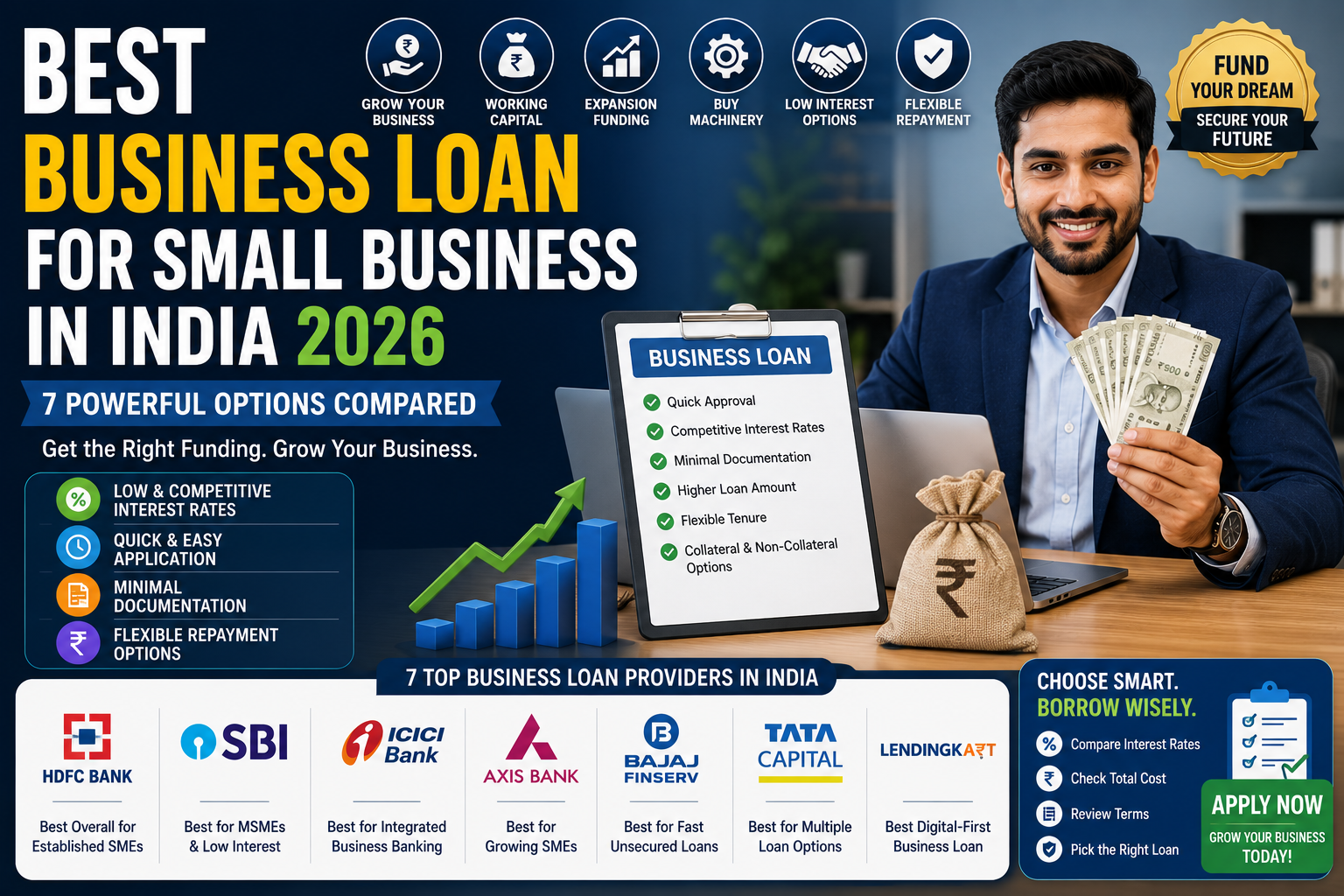
For 2026, seven lenders worth comparing are:
| Lender | Best For | Main Strength |
|---|---|---|
| HDFC Bank | Established SMEs | Broad business-loan range |
| SBI | MSMEs | Large public-sector lending ecosystem |
| ICICI Bank | Established businesses | Business banking & financing |
| Axis Bank | SMEs | Digital business lending |
| Bajaj Finance | Fast unsecured funding | Digital application |
| Tata Capital | Growing businesses | Multiple business-finance products |
| Lendingkart | Digital-first SMEs | Data-driven underwriting |
Current market comparisons show substantial differences between lenders. For example, published business-loan rates in August 2026 range from around 9.50% at the lower end for some Kotak products to substantially higher rates for some NBFC products, demonstrating why borrowers should compare the actual offer rather than relying on a single advertised rate.
1. HDFC Bank Business Loan — Best Overall for Established SMEs
HDFC Bank offers several business-financing products for small and medium businesses.
Its current published business-loan information shows a rack interest-rate range of 10.75% to 22.50% per annum. Processing charges can be up to 2% of the loan amount.
HDFC also currently states that eligible micro and small enterprises can receive a processing-fee waiver for loan facilities up to ₹5 lakh, subject to its stated Udyam Registration Certificate conditions.
Best For
- Established SMEs
- Service businesses
- Traders
- Manufacturers
- Professionals
- Businesses with documented financial history
Potential Advantages
- Established banking network
- Business banking ecosystem
- Digital application options
- Multiple financing products
- Working-capital solutions
Important
The published rate is a range, not a guaranteed rate for every borrower.
The actual offer can depend on:
- Credit profile
- Business vintage
- Turnover
- Financial performance
- Banking relationship
- Loan amount
- Security
Verdict: A strong first option to compare if your business has an established financial history.
2. SBI Business Loan — Best for MSME Financing
State Bank of India has a large MSME lending ecosystem with multiple business-financing products.
SBI can be particularly relevant for businesses looking for:
- Working capital
- Term loans
- Machinery finance
- MSME financing
- Digital business loans
- Government-supported schemes
Best For
- MSMEs
- Traders
- Manufacturers
- Established businesses
- Businesses looking for public-sector banking
Potential Advantages
- Large branch network
- Multiple MSME products
- Government-linked financing ecosystem
- Business banking services
Considerations
Traditional lenders may require more documentation and financial information.
Businesses should compare:
- Interest rate
- Collateral
- Processing time
- Documentation
- Repayment terms
Verdict: A strong lender to include in any serious MSME loan comparison.
3. ICICI Bank Business Loan — Best for Business Banking Integration
ICICI Bank offers business loans and other financing solutions for SMEs.
Its business-banking ecosystem includes financing options such as:
- Business loans
- Working capital
- Overdraft
- Trade finance
- Invoice-related finance
- GST-linked financing
- Equipment finance
Best For
- Established SMEs
- Traders
- Manufacturers
- Service businesses
- Businesses already banking with ICICI
Why Consider It?
Businesses with an existing banking relationship may find it convenient to keep:
Current Account + Payments + Working Capital + Business Loan
within the same banking ecosystem.
Verdict: Worth comparing if you want financing integrated with broader business banking.
4. Axis Bank Business Loan — Best for Growing SMEs
Axis Bank offers business-financing solutions for SMEs and established businesses.
The bank provides products across areas such as:
- Term loans
- Working capital
- Business loans
- Overdraft
- Equipment finance
Axis Bank’s business-lending ecosystem is particularly relevant for companies that need financing as they scale.
Best For
- Growing businesses
- Established SMEs
- Manufacturers
- Traders
- Service businesses
Important
As with other lenders, the final interest rate depends on borrower-specific underwriting.
Verdict: A useful lender to compare when your business has established revenue and needs growth capital.
5. Bajaj Finance Business Loan — Best for Digital Unsecured Funding
Bajaj Finance is an NBFC offering business financing, including unsecured business loans for eligible borrowers.
Current market data lists Bajaj Finserv business-loan rates around 14%–23.50% per annum, although the actual rate offered depends on the borrower and product.
Best For
- Small businesses
- Self-employed professionals
- Established businesses
- Businesses seeking unsecured financing
Potential Advantages
- Digital application
- Established NBFC
- Unsecured options
- Faster application process for eligible borrowers
Considerations
Unsecured financing can be more expensive than some secured financing.
Always compare:
Interest + processing fee + foreclosure charges + other applicable fees.
Verdict: Worth considering when speed and unsecured financing are more important than getting the absolute lowest rate.
6. Tata Capital Business Loan — Best for Growing Businesses
Tata Capital offers multiple financing solutions for businesses.
These can include:
- Business loans
- Working capital
- Equipment finance
- Commercial vehicle finance
- Structured business financing
Current market data lists Tata Capital business-loan rates from around 12% onwards, although actual pricing depends on borrower and product.
Best For
- Growing SMEs
- Established businesses
- Equipment purchases
- Expansion
Pros
- Broad financing ecosystem
- Multiple business products
- Established financial institution
Verdict: A good lender to compare when your financing requirement is larger or more specialized than a basic unsecured loan.
7. Lendingkart — Best Digital-First Business Loan
Lendingkart focuses on digital business lending.
Its technology-driven approach can be useful for businesses that want an online application process.
Current market data lists Lendingkart business-loan rates from approximately 13.50% onwards, with actual pricing depending on the borrower and loan product.
Best For
- Small businesses
- Online businesses
- Traders
- Service businesses
- Businesses seeking digital applications
Potential Advantages
- Digital-first process
- Data-driven underwriting
- Online documentation
- SME focus
Considerations
Compare the total cost carefully because digital convenience does not necessarily mean the lowest borrowing cost.
Verdict: Worth evaluating if a fast, online-first borrowing experience is important.
Business Loan Comparison
| Lender | Best For | Rate Position | Collateral | Application |
| HDFC Bank | Established SMEs | Competitive range | Depends on product | Digital + branch |
| SBI | MSMEs | Product-dependent | Depends on scheme | Branch + digital |
| ICICI Bank | Established businesses | Risk-based | Depends on product | Digital + branch |
| Axis Bank | Growing SMEs | Risk-based | Depends on product | Digital + branch |
| Bajaj Finance | Unsecured funding | Generally higher | Often unsecured | Digital |
| Tata Capital | Growing businesses | Product-dependent | Depends on product | Digital + branch |
| Lendingkart | Digital SMEs | Risk-based | Often unsecured | Digital |
Important: “Rate position” is an editorial comparison, not a guaranteed offer. Actual rates and collateral requirements depend on the loan product and borrower.
Types of Business Loans
Choosing the correct loan type can be more important than choosing the lender.
1. Term Loan
You receive a fixed amount and repay it through scheduled EMIs.
Suitable For
- Expansion
- Machinery
- Renovation
- Business equipment
- Large purchases
2. Working Capital Loan
Working-capital financing helps businesses manage day-to-day operating requirements.
Suitable For
- Inventory
- Supplier payments
- Payroll
- Operating expenses
- Short-term cash-flow gaps
3. Business Line of Credit
A line of credit allows an eligible business to draw funds as needed up to an approved limit.
This can be useful when cash-flow requirements fluctuate.
4. Overdraft
An overdraft facility can allow a business to withdraw money above its available account balance up to an approved limit.
Interest may be charged based on the amount utilized, depending on the facility.
5. Equipment Finance
Used specifically to purchase:
- Machinery
- Computers
- Commercial equipment
- Vehicles
- Production equipment
6. Invoice Financing
Businesses can potentially obtain financing against eligible invoices rather than waiting for customers to pay.
This can be useful for B2B businesses with long payment cycles.
7. Government-Backed MSME Financing
Government-supported programs can be useful for eligible businesses.
Examples include:
- PMMY / Mudra
- CGTMSE-backed financing
- Other MSME schemes
Eligibility and loan limits vary by scheme and can change.
Always check the latest official scheme guidelines before applying.
Secured vs Unsecured Business Loan
Secured Business Loan
A secured loan is backed by eligible collateral.
Advantages
- Potentially lower interest rate
- Higher borrowing capacity
- Longer tenure may be available
Disadvantages
- Collateral required
- Documentation can be more extensive
- Approval may take longer
Unsecured Business Loan
An unsecured loan generally does not require property or other traditional collateral.
Advantages
- Faster application
- No traditional collateral
- Easier for some businesses
Disadvantages
- Usually higher interest
- Lower loan limits may apply
- Strong credit and business history may still be required
Business Loan Interest Rates in India
Business loan rates vary significantly.
As of August 2026, HDFC Bank publishes a business-loan rack range of 10.75%–22.50% per annum.
A current market comparison lists:
| Lender | Indicative Rate |
| Axis Bank | 10.99% onwards |
| HDFC Bank | 10.75%–22.50% |
| Bajaj Finserv | 14%–23.50% |
| Tata Capital | 12% onwards |
| Lendingkart | 13.50% onwards |
| Kotak Mahindra Bank | 9.50%–30.50% |
These figures were published/updated in August 2026 and are indicative; the final rate depends on the lender, product and borrower profile.
What Determines Your Rate?
Lenders may consider:
- CIBIL/credit history
- Business vintage
- Annual turnover
- Profitability
- GST filings
- ITR
- Bank statements
- Existing debt
- Loan amount
- Loan tenure
- Collateral
- Industry risk
A strong borrower may receive substantially better pricing than a high-risk borrower.
Business Loan Eligibility
Eligibility differs between lenders.
Common factors include:
Business Vintage
Many lenders prefer businesses with an established operating history.
Turnover
Higher and stable revenue can strengthen the application.
Credit Score
Both the business and promoter’s credit profile may be relevant depending on the product.
Banking History
Regular banking transactions and stable cash flow can help demonstrate repayment capacity.
GST History
For GST-registered businesses, lenders may review GST returns and turnover.
Income Tax Returns
ITRs help demonstrate reported income and business performance.
Documents Required
Typical documents can include:
- PAN
- Aadhaar/KYC
- GST certificate
- GST returns
- ITR
- Bank statements
- Business registration documents
- Partnership deed
- Certificate of incorporation
- Financial statements
- Profit & loss statement
- Balance sheet
- Business address proof
The exact requirements depend on the lender, loan product and business structure.
How to Improve Business Loan Approval Chances
1. Maintain a Strong Credit Profile
Pay existing EMIs and credit-card dues on time.
Avoid unnecessary credit applications before applying for a major loan.
2. Keep Financial Records Organized
Maintain:
- ITR
- GST returns
- Bank statements
- Financial statements
in a consistent and accurate manner.
3. Separate Personal and Business Transactions
Use a dedicated business current account.
This makes business cash flow easier for lenders to understand.
4. Reduce Existing Debt
High existing obligations can reduce your borrowing capacity.
5. Maintain Stable Banking Transactions
Avoid unexplained large cash movements.
6. Choose a Realistic Loan Amount
Do not borrow significantly more than your business can repay.
How to Calculate the Real Cost
Suppose you borrow:
₹10,00,000
at an annual interest rate of:
12%
for:
3 years
The EMI is approximately ₹33,214.
Total repayment would be approximately:
₹11,95,704
Total interest:
₹1,95,704
This is only an illustration. Actual EMI calculations depend on the lender’s repayment structure and applicable charges.
But There Is More
Suppose the lender also charges:
2% processing fee = ₹20,000
Then the effective cost is higher.
You should therefore compare:
Interest + Processing Fee + GST on Applicable Charges + Other Fees + Foreclosure Cost
rather than comparing interest rates alone.
Business Loan vs Business Credit Card
| Feature | Business Loan | Business Credit Card |
| Large Funding | ✅ | Limited |
| Short-Term Expenses | ✅ | ✅ |
| Fixed EMI | Usually | ❌ |
| Working Capital | ✅ | ✅ |
| Rewards | Usually Limited | Often |
| Interest Cost | Usually Lower | Can be High if Revolved |
| Large Equipment Purchase | ✅ | Usually Not Ideal |
| Expense Tracking | Depends | Often Strong |
For larger investments, a structured business loan may be more appropriate.
For short-term expenses, a business credit card or line of credit may be more flexible.
Common Business Loan Mistakes
Mistake 1: Choosing the Lowest Advertised Rate
The lowest advertised rate may apply only to a particular borrower profile.
Always compare the rate actually offered to you.
Mistake 2: Ignoring Processing Fees
A 1%–2% fee can represent a significant amount on a large loan.
Mistake 3: Taking a Longer Tenure Just to Reduce EMI
A longer tenure can lower the monthly EMI but increase total interest paid.
Mistake 4: Borrowing Without a Repayment Plan
Before borrowing, estimate:
Expected monthly cash flow − existing obligations − new EMI
Make sure the business can comfortably handle the repayment.
Mistake 5: Applying to Too Many Lenders
Multiple loan applications can create unnecessary credit inquiries depending on the lender and credit bureau.
Mistake 6: Not Reading Foreclosure Terms
If your business generates extra cash later, you may want to repay the loan early.
Check applicable prepayment and foreclosure charges.
HDFC Bank, for example, currently publishes different premature-closure charges depending on the repayment period and product, while certain eligible fixed-rate loans for micro and small enterprises can have no premature-closure charge subject to stated conditions.
Frequently Asked Questions
What is the best business loan for small business in India?
There is no universal best loan. HDFC Bank and SBI can be strong options for established SMEs, ICICI and Axis are worth comparing for business-banking relationships, while Bajaj Finance and Lendingkart may be useful when unsecured or digital-first financing is important.
Which bank gives the lowest business loan interest rate?
There is no single lowest rate for every borrower. Published rates vary by lender and product, and the final rate depends on credit profile, turnover, business history, collateral and other underwriting factors.
Can I get a business loan without collateral?
Yes, eligible borrowers can obtain unsecured business loans from some banks and NBFCs. However, unsecured loans may carry higher interest rates than secured financing.
How much business loan can I get?
The amount depends on your business revenue, profitability, credit profile, banking history, existing debt, loan purpose and lender policy.
What credit score is required for a business loan?
There is no single universal score requirement. A stronger credit profile generally improves the likelihood of approval and competitive pricing.
Can a new business get a business loan?
New businesses can have fewer financing options because lenders often prefer established revenue and financial history. Government-backed schemes, secured loans and specialized startup financing may provide alternatives depending on eligibility.
Is GST required for a business loan?
Not always. Requirements vary by lender, business type and loan product. GST registration and returns can be important for businesses that are required to be registered.
How long does a business loan take?
Processing time varies by lender and loan type. Digital unsecured loans can potentially be faster, while secured or larger loans can require more documentation and underwriting.
Is a business loan better than a personal loan?
For a genuine business requirement, compare business financing with personal financing based on interest, tax/accounting implications, repayment terms and eligibility. A business loan may be more appropriate for structured business funding, but the right choice depends on the situation.
Final Verdict
The best business loan for small business in India is the one that provides the required capital at a sustainable total cost.
Choose HDFC Bank if you want a broad business-banking ecosystem and have an established business profile.
Choose SBI if you want to explore a wide MSME lending ecosystem and government-linked financing options.
Choose ICICI Bank if integrated business banking and financing are important.
Choose Axis Bank if you are a growing SME looking for multiple business-finance products.
Choose Bajaj Finance if an unsecured, digital-first application is a priority.
Choose Tata Capital if you need broader business financing and are comparing established NBFC options.
Choose Lendingkart if you prefer a digital-first SME lending process.
Before accepting any offer, compare:
Interest Rate + Processing Fee + GST + EMI + Tenure + Foreclosure Charges + Total Repayment
For example, a loan with a slightly higher interest rate but significantly lower fees can sometimes have a lower total borrowing cost than an apparently cheaper loan.
The goal should not be simply to get a business loan.
The goal should be to obtain the right amount of capital at a cost your business can comfortably repay.