Best Expense Management Software for Small Business in 2026: 7 Powerful Tools Compared
Managing business expenses sounds simple until the number of receipts, employees, subscriptions, travel expenses and company purchases starts growing.
A small business may have expenses coming from:
- Corporate cards
- Employee reimbursements
- Online subscriptions
- Travel
- Meals
- Software
- Office supplies
- Advertising
- Vendor payments
When these expenses are tracked manually, finance teams can spend hours collecting receipts, checking transactions and preparing reports.
That’s where expense management software can help.
The best expense management software for small business can automate receipt collection, expense reports, approvals, reimbursements, spending policies and accounting workflows.
In this guide, we’ll compare 7 powerful expense management platforms in 2026 and explain which type of business each one is best suited for.
Table of Contents
- What Is Expense Management Software?
- Why Small Businesses Need Expense Management Software
- Best Expense Management Software for Small Business
- Ramp
- Brex
- Expensify
- Zoho Expense
- BILL Spend & Expense
- Navan
- SAP Concur
- Expense Management Comparison
- Important Features to Look For
- Corporate Cards vs Expense Software
- Expense Management for Different Businesses
- How Much Does Expense Management Software Cost?
- Expense Software vs Spreadsheets
- Common Expense Management Mistakes
- Frequently Asked Questions
- Final Verdict
What Is Expense Management Software?
Expense management software helps businesses record, monitor, approve and analyze company spending.
Instead of collecting paper receipts and manually entering transactions into spreadsheets, businesses can automate much of the process.
Modern expense platforms can manage:
- Receipt capture
- Expense reports
- Employee reimbursements
- Corporate cards
- Spending policies
- Approval workflows
- Mileage
- Travel expenses
- Purchase requests
- Accounting integrations
- Expense analytics
- Budget controls
Some platforms also combine expense management with:
- Corporate cards
- Accounts payable
- Bill payment
- Travel management
- Procurement
- Accounting
The main goal is to give businesses better visibility and control over company spending.
Why Small Businesses Need Expense Management Software
Manual expense management can create several problems.
Employees may forget receipts.
Managers may approve expenses late.
Finance teams may spend hours matching receipts to card transactions.
Businesses can also struggle to understand where money is being spent.
For example, a company might discover that its employees are spending heavily on:
- Software subscriptions
- Business travel
- Advertising
- Meals
- Freelance services
- Office equipment
Without good reporting, these costs can remain hidden.
Expense management software can make spending easier to monitor.
Main Benefits
Save Time
Automate receipt collection and expense reports.
Reduce Errors
Reduce manual data entry and duplicate transactions.
Improve Visibility
See business spending in one place.
Enforce Policies
Create rules for employee spending.
Speed Up Reimbursements
Process approved employee expenses faster.
Improve Accounting
Send expense data directly to accounting systems.
Control Spending
Set budgets, limits and approval workflows.
Recent 2026 industry comparisons highlight receipt capture, reimbursements, approval workflows, corporate cards, accounting integrations and real-time spend visibility as major capabilities in modern expense management platforms.
Best Expense Management Software for Small Business
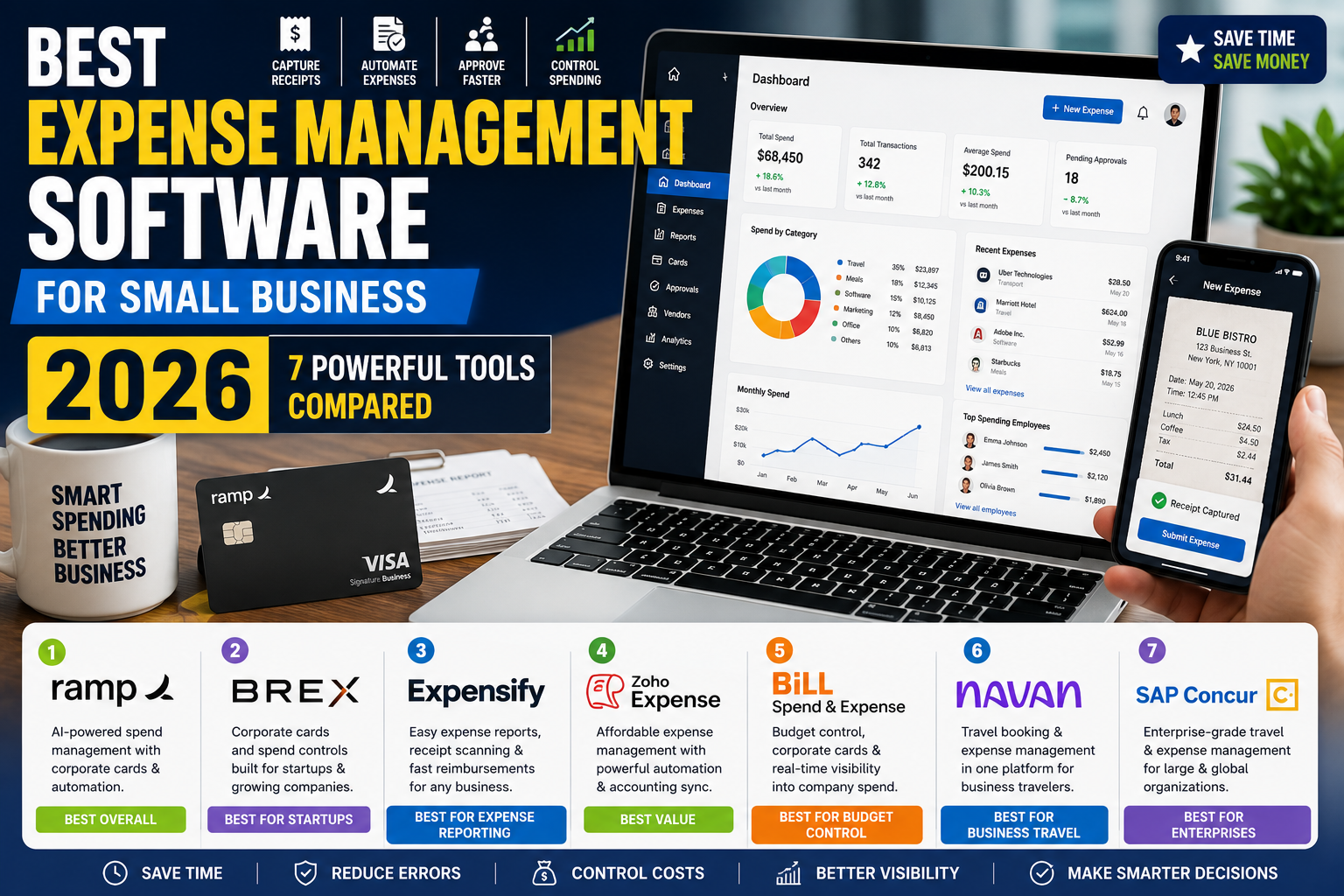
For 2026, these seven platforms are worth comparing:
| Software | Best For | Main Strength |
|---|---|---|
| Ramp | Spend automation | AI + corporate cards |
| Brex | Startups & growing companies | Corporate cards + spend management |
| Expensify | Expense reporting | Receipt capture & reimbursements |
| Zoho Expense | Small businesses | Affordable expense automation |
| BILL Spend & Expense | Budget control | Cards + spending controls |
| Navan | Business travel | Travel + expense management |
| SAP Concur | Large organizations | Enterprise expense management |
A 2026 comparison from Ramp similarly highlights Ramp, AppZen, BILL Spend & Expense, Zoho Expense, Expensify, Navan and SAP Concur among notable expense-management platforms, with different products suited to different business requirements.
1. Ramp — Best Overall


4
Ramp combines expense management with corporate cards and broader spend-management tools.
This makes it particularly useful for businesses that want to control spending before and after transactions happen.
Key Features
- Corporate cards
- Virtual cards
- Expense management
- Receipt capture
- Spending controls
- Approval workflows
- Bill payments
- Accounts payable
- Vendor management
- Spend analytics
- Accounting integrations
- AI-powered expense review
Ramp currently offers a free tier, while its Plus plan is listed at $15 per user per month, plus a platform fee that can vary based on team size.
Best For
- Startups
- Technology companies
- Growing businesses
- Finance teams
- Companies wanting corporate-card controls
Advantages
- Strong spend controls
- Corporate cards
- Automation
- AI features
- Expense management
- AP functionality
Disadvantages
- Some advanced functionality is aimed at larger businesses
- Pricing can involve more than a simple per-user subscription
Verdict: One of the strongest choices for businesses that want expense management combined with proactive spending controls.
2. Brex — Best for Startups & Growing Companies


6
Brex combines corporate cards, expense management and business-spend controls.
The platform is particularly well known among startups and technology companies.
Key Features
- Corporate cards
- Virtual cards
- Expense management
- Reimbursements
- Spending controls
- Approval workflows
- Accounting integrations
- Travel management
- Spend analytics
- Automated expense processes
Brex currently lists an Essentials free plan and a Premium plan at $12 per user per month; enterprise options are custom.
Best For
- Startups
- Technology companies
- Growing businesses
- Companies with corporate-card requirements
Advantages
- Corporate cards
- Spending controls
- Expense management
- Automation
- Finance integrations
Disadvantages
- Best value may come when using its broader financial ecosystem
- Availability and product terms can vary by market
Verdict: A strong choice for startups and growing companies that want corporate cards and expense management in one platform.
3. Expensify — Best for Expense Reporting


5
Expensify focuses heavily on expense reporting, receipt capture and reimbursements.
Its receipt-scanning workflow can reduce the amount of manual data entry required from employees.
Key Features
- Receipt scanning
- Expense reports
- Employee reimbursements
- Corporate cards
- Approval workflows
- Expense policies
- Accounting integrations
- Travel expenses
- Mobile application
- Automatic expense categorization
Current 2026 comparisons list Expensify’s Collect plan at around $5 per member/month, while Control pricing can start around $9 depending on the billing and card conditions.
Best For
- Small teams
- Remote businesses
- Consultants
- Agencies
- Companies focused on reimbursements
Advantages
- Easy receipt capture
- Mobile-friendly
- Reimbursements
- Expense reports
- Accounting integrations
Disadvantages
- Advanced spend controls may require other tools
- Pricing can depend on active users and plan conditions
Verdict: A strong option for businesses that mainly need simple expense reporting, receipt management and employee reimbursements.
4. Zoho Expense — Best Value


6
Zoho Expense is designed specifically for business expense management.
It can handle everything from receipt scanning to employee reimbursements and expense approvals.
Key Features
- Receipt capture
- AI-powered OCR
- Expense reports
- Employee reimbursements
- Mileage tracking
- Corporate card management
- Expense policies
- Approval workflows
- Multi-currency expenses
- Accounting integrations
- Travel expenses
- Audit trails
Zoho currently lists a free plan for up to 3 users in its published pricing, with paid Standard and Premium tiers. Pricing varies by region.
Best For
- Small businesses
- Startups
- Agencies
- Remote teams
- Businesses already using Zoho products
Advantages
- Free entry option
- Receipt OCR
- Expense automation
- Multi-currency
- Strong integrations
- Good value
Disadvantages
- Paid plans can have minimum-user requirements
- Advanced travel and automation features require higher plans
Verdict: One of the strongest options for small businesses looking for dedicated expense management at a competitive price.
5. BILL Spend & Expense — Best for Budget Control


BILL Spend & Expense combines corporate spending controls with expense management.
It can be useful for businesses that want to establish budgets and control spending before transactions happen.
Key Features
- Corporate cards
- Virtual cards
- Expense management
- Budget controls
- Spending limits
- Reimbursements
- Approval workflows
- Accounting integrations
- Spend reporting
Current 2026 comparisons list BILL Spend & Expense with a $0 entry price, with spending controls and cashback positioned as major features.
Best For
- Small businesses
- Growing companies
- Finance teams
- Businesses wanting spending limits
Advantages
- Budget controls
- Corporate cards
- Expense management
- Spend visibility
- Accounting integrations
Disadvantages
- Businesses may not need the card ecosystem
- Product availability can vary by market
Verdict: A good option when controlling employee and company spending is a major priority.
6. Navan — Best for Business Travel


7
Navan combines business travel and expense management.
This can be particularly valuable for businesses where employees travel frequently.
Key Features
- Business travel booking
- Travel expense management
- Receipt matching
- Expense reports
- Corporate travel policies
- Employee spending
- Travel analytics
- Reimbursements
- Corporate card integrations
Current 2026 comparisons describe Navan as particularly suited to businesses wanting travel booking and expense management in one platform.
Best For
- Consulting companies
- Sales teams
- Remote organizations
- International companies
- Businesses with frequent travel
Advantages
- Travel + expenses
- Automated receipt matching
- Travel policies
- Expense visibility
Disadvantages
- Less relevant if employees rarely travel
- Full functionality may be unnecessary for a very small local business
Verdict: One of the better options for companies where business travel represents a significant portion of expenses.
7. SAP Concur — Best for Enterprise Expense Management


6
SAP Concur is designed for organizations with sophisticated travel, expense and financial-management requirements.
It is more enterprise-focused than many of the other platforms in this list.
Key Features
- Expense reporting
- Travel management
- Corporate cards
- Policy enforcement
- Approval workflows
- Expense analytics
- ERP integrations
- Audit capabilities
- Global expense management
Best For
- Large businesses
- International organizations
- Enterprise finance teams
- Businesses with complex travel policies
Advantages
- Enterprise capabilities
- Detailed reporting
- Policy controls
- Global functionality
- Strong integration capabilities
Disadvantages
- Can be excessive for a very small business
- Pricing is generally quote-based
- Implementation may require more planning
Verdict: Best suited to larger businesses with complex expense and travel-management requirements.
Expense Management Comparison
| Feature | Ramp | Brex | Expensify | Zoho Expense | BILL | Navan | SAP Concur |
|---|---|---|---|---|---|---|---|
| Receipt Capture | ⭐⭐⭐⭐⭐ | ⭐⭐⭐⭐ | ⭐⭐⭐⭐⭐ | ⭐⭐⭐⭐⭐ | ⭐⭐⭐⭐ | ⭐⭐⭐⭐ | ⭐⭐⭐⭐⭐ |
| Reimbursements | ✅ | ✅ | ✅ | ✅ | ✅ | ✅ | ✅ |
| Corporate Cards | ✅ | ✅ | ✅ | ✅ | ✅ | ✅ | ✅ |
| Approval Workflows | ⭐⭐⭐⭐⭐ | ⭐⭐⭐⭐⭐ | ⭐⭐⭐⭐ | ⭐⭐⭐⭐⭐ | ⭐⭐⭐⭐⭐ | ⭐⭐⭐⭐ | ⭐⭐⭐⭐⭐ |
| Spend Controls | ⭐⭐⭐⭐⭐ | ⭐⭐⭐⭐⭐ | ⭐⭐⭐ | ⭐⭐⭐⭐ | ⭐⭐⭐⭐⭐ | ⭐⭐⭐⭐ | ⭐⭐⭐⭐⭐ |
| Travel Management | ⭐⭐⭐ | ⭐⭐⭐⭐ | ⭐⭐⭐ | ⭐⭐⭐⭐ | ⭐⭐⭐ | ⭐⭐⭐⭐⭐ | ⭐⭐⭐⭐⭐ |
| Accounting Integration | ⭐⭐⭐⭐⭐ | ⭐⭐⭐⭐⭐ | ⭐⭐⭐⭐⭐ | ⭐⭐⭐⭐⭐ | ⭐⭐⭐⭐⭐ | ⭐⭐⭐⭐ | ⭐⭐⭐⭐⭐ |
| Best For | Spend Automation | Startups | Expense Reports | Small Business | Budgets | Travel | Enterprise |
Note: These are editorial comparisons, not independent benchmark scores. Features and availability can vary by plan and country.
Important Features to Look For
When choosing the best expense management software for small business, consider your actual spending workflow.
1. Receipt Capture
Employees should be able to capture receipts using:
- Smartphone cameras
- Uploads
- Mobile applications
- Corporate card transactions
AI-powered OCR can extract information such as:
- Merchant
- Date
- Amount
- Tax
- Currency
This reduces manual entry.
2. Expense Approval
A good approval system should allow businesses to create rules.
For example:
Under $100 → Manager Approval
$100–$1,000 → Department Manager
Over $1,000 → Finance Approval
This can improve financial control.
3. Corporate Cards
Corporate cards can help businesses centralize employee spending.
Look for:
- Spending limits
- Merchant restrictions
- Virtual cards
- Real-time notifications
- Card controls
- Automatic transaction matching
4. Reimbursements
Employees often pay for business expenses personally.
A good platform should allow employees to:
- Upload receipt
- Enter expense
- Submit report
- Receive approval
- Get reimbursed
5. Expense Policies
Businesses can create rules such as:
- Maximum hotel budget
- Meal allowance
- Travel limits
- Mileage rate
- Receipt requirements
- Approval requirements
This helps prevent unnecessary spending.
6. Accounting Integrations
Expense software should ideally connect with your accounting system.
Common integrations include:
- QuickBooks
- Xero
- NetSuite
- Sage
- ERP systems
- Payroll systems
This can reduce duplicate data entry.
7. Multi-Currency
For international companies, multi-currency support is extremely important.
Employees may spend money in:
- USD
- EUR
- GBP
- CAD
- AUD
- SGD
- AED
The system should automatically record the appropriate currency and exchange-rate information where supported.
Corporate Cards vs Expense Software
These are not always the same thing.
Corporate Card
A corporate card is primarily a payment instrument.
It can help control spending but may not provide comprehensive expense reporting.
Expense Management Software
Expense software can manage:
- Receipts
- Reports
- Approvals
- Reimbursements
- Policies
- Accounting
Spend Management Platform
Modern platforms increasingly combine both.
For example:
Corporate Card + Expense Software + Approval + Accounting + Analytics
This can provide significantly better visibility into business spending.
Expense Management for Different Businesses
Freelancers
Freelancers may only need:
- Receipt capture
- Expense categorization
- Mileage
- Tax records
- Basic reports
A full corporate-card platform may be unnecessary.
Agencies
Agencies may need:
- Employee expenses
- Client-billable expenses
- Approvals
- Project tracking
- Reimbursements
Zoho Expense, Expensify and Ramp are worth comparing.
Startups
Startups often need:
- Corporate cards
- Employee spending
- Budgets
- Approval workflows
- Accounting integration
Ramp and Brex can be particularly attractive.
International Businesses
International businesses should prioritize:
- Multi-currency
- Global reimbursements
- International travel
- Local tax handling
- Multi-entity support
- Accounting integrations
Platforms such as Ramp, Navan and SAP Concur may be relevant depending on size and location.
Large Enterprises
Large organizations usually need:
- Complex approval policies
- Travel management
- Audit controls
- ERP integration
- Multi-entity reporting
- Global compliance
SAP Concur is designed for this type of environment.
How Much Does Expense Management Software Cost?
Expense-management pricing can vary significantly.
Common models include:
- Free plans
- Per-user pricing
- Active-user pricing
- Corporate-card models
- Quote-based enterprise pricing
A current 2026 comparison shows examples including Ramp at $0 for its free tier, Ramp Plus at $15/user/month plus a platform fee, Brex Essentials at $0, Brex Premium at $12/user/month, Expensify starting around $5/member/month and Zoho Expense with a free tier for up to three users.
But Price Isn’t Everything
Calculate the total cost of ownership.
Consider:
- Subscription
- Card fees
- Payment-processing fees
- Implementation
- Integration
- Support
- Employee training
- Accounting software
- Travel management
A more expensive platform can potentially save money if it significantly reduces manual finance work and unnecessary spending.
Expense Software vs Spreadsheets
| Feature | Spreadsheet | Expense Software |
|---|---|---|
| Receipt Capture | Manual | ✅ |
| Expense Reports | Manual | ✅ |
| Approvals | Manual | ✅ |
| Reimbursements | Manual | ✅ |
| Corporate Cards | Limited | ✅ |
| Spending Policies | Manual | ✅ |
| Accounting Integration | Limited | ✅ |
| Real-Time Visibility | Limited | ✅ |
| Automation | Limited | ✅ |
| Audit Trail | Limited | ✅ |
Spreadsheets can work for a very small operation.
But once multiple employees start submitting expenses, dedicated software can significantly improve the workflow.
Common Expense Management Mistakes
Mistake 1: Collecting Receipts at Month-End
Waiting until the end of the month creates unnecessary work.
Use mobile receipt capture whenever possible.
Mistake 2: No Spending Policies
Employees should know what the business will and won’t reimburse.
Mistake 3: Giving Employees Unlimited Spending
Set appropriate card limits and approval thresholds.
Mistake 4: Ignoring Small Recurring Expenses
Software subscriptions can accumulate over time.
Review recurring expenses regularly.
Mistake 5: Not Connecting Accounting Software
Manual data transfer creates unnecessary work and errors.
Mistake 6: Choosing Software Based Only on Price
A cheap system may lack the automation your finance team needs.
Mistake 7: Ignoring Security
Expense systems contain sensitive financial information.
Use:
- Multi-factor authentication
- Role-based permissions
- Secure integrations
- Audit trails
- Strong password policies
Frequently Asked Questions
What is the best expense management software for small business?
Zoho Expense and Expensify are strong options for smaller businesses focused on expense reporting, while Ramp and Brex are attractive when corporate cards and spend controls are important. Navan is particularly useful for travel-heavy businesses, while SAP Concur is better suited to complex enterprise requirements.
What does expense management software do?
It helps businesses capture receipts, record expenses, manage reimbursements, approve spending, enforce policies and connect expenses with accounting systems.
Is expense management software worth it?
For businesses with multiple employees and recurring expenses, it can save significant administrative time and improve spending visibility.
Can expense software replace accounting software?
Usually not. Expense software focuses primarily on spending and reimbursements. Accounting software manages the broader financial records of the business.
Can employees submit expenses from their phones?
Many modern expense platforms provide mobile applications that allow employees to capture receipts and submit expenses.
Can expense software manage corporate cards?
Yes. Many modern spend-management platforms combine corporate cards with expense reporting and spending controls.
What is the difference between expense management and spend management?
Expense management generally focuses on recording and processing expenses.
Spend management is broader and can include:
Budgets + Corporate Cards + Procurement + Vendor Payments + Expense Management + Analytics
Can expense management software work internationally?
Many platforms support multiple currencies and international businesses, but country availability, tax functionality, reimbursement methods and card availability vary.
Is free expense management software available?
Yes. Several platforms currently offer free tiers or free core functionality, although feature and user limits may apply.
Final Verdict
The best expense management software for small business depends on how your company spends money.
Choose Ramp
If you want powerful spend controls, corporate cards and automation.
Choose Brex
If you’re a startup or growing business that wants corporate cards and integrated spend management.
Choose Expensify
If your main requirement is receipt capture, expense reports and reimbursements.
Choose Zoho Expense
If you want strong features at a competitive price and easy accounting integration.
Choose BILL Spend & Expense
If budget control and spending limits are important.
Choose Navan
If business travel represents a significant portion of company expenses.
Choose SAP Concur
If your company needs enterprise-level travel and expense management.
Before choosing a platform, compare:
Price + Receipt Capture + Approvals + Reimbursements + Corporate Cards + Accounting Integrations + Security
The best system isn’t necessarily the one with the most features.
It’s the platform that makes it easy for employees to submit expenses, easy for managers to approve them and easy for finance teams to control company spending.
A well-designed expense-management system can help businesses:
Capture Receipts → Control Spending → Automate Approvals → Reduce Manual Work → Improve Cash Flow
That makes expense management software an important part of a modern small-business finance stack.