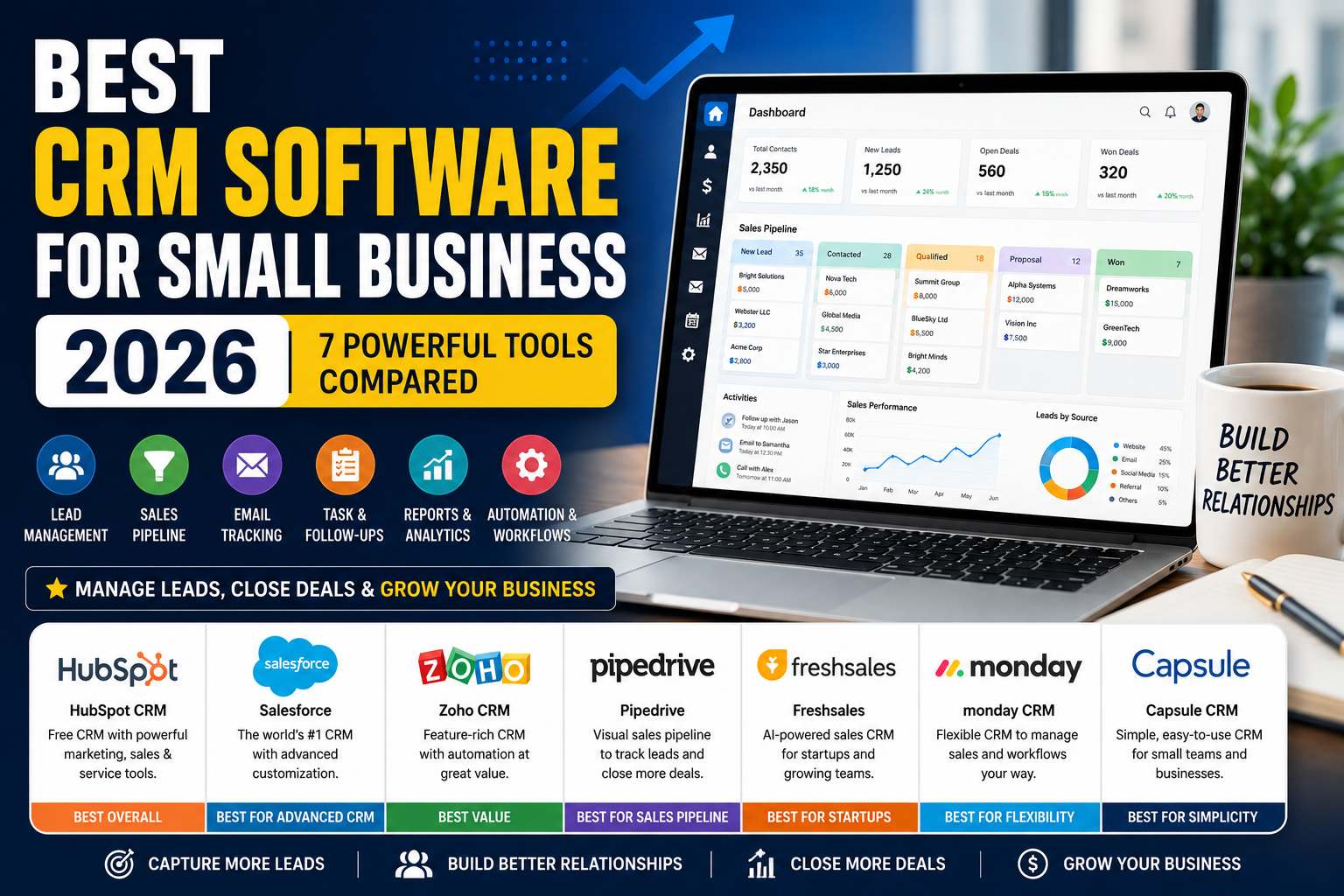
Best CRM Software for Small Business in 2026: 7 Powerful Tools Compared
Managing customers becomes increasingly difficult as a business grows.
Leads come from websites, social media, email, phone calls and advertising campaigns.
Without a centralized system, sales teams can easily lose track of:
- New leads
- Customer conversations
- Follow-ups
- Sales opportunities
- Quotes
- Deals
- Existing customers
That’s where CRM software can help.
The best CRM software for small business brings customer information, sales activities, communication and follow-ups into one centralized platform.
In this guide, we’ll compare 7 powerful CRM platforms in 2026, explain their key features and help you choose the right CRM for your business.
Table of Contents
- What Is CRM Software?
- Why Small Businesses Need CRM Software
- Best CRM Software for Small Business
- HubSpot CRM
- Salesforce
- Zoho CRM
- Pipedrive
- Freshsales
- monday CRM
- Capsule CRM
- CRM Comparison Table
- Important CRM Features
- CRM for Different Types of Businesses
- Cloud CRM vs Desktop CRM
- How Much Does CRM Software Cost?
- CRM vs Spreadsheet
- Common CRM Mistakes
- Frequently Asked Questions
- Final Verdict
What Is CRM Software?
CRM stands for Customer Relationship Management.
CRM software helps businesses organize and manage interactions with potential and existing customers.
A CRM can store information such as:
- Customer names
- Email addresses
- Phone numbers
- Companies
- Leads
- Sales opportunities
- Conversations
- Meetings
- Tasks
- Quotes
- Deals
- Follow-up dates
Instead of keeping customer information in spreadsheets, email inboxes and notebooks, a CRM creates a centralized customer database.
A typical sales process can look like:
Lead → Contact → Qualification → Opportunity → Proposal → Negotiation → Won Deal
CRM software helps sales teams manage each stage.
Why Small Businesses Need CRM Software
Many small businesses start by managing customers through spreadsheets.
This can work temporarily.
But as the number of leads increases, problems start appearing.
For example:
- Salespeople forget follow-ups
- Leads aren’t assigned properly
- Customer information is duplicated
- Sales opportunities are lost
- Managers don’t know the sales pipeline
- Emails are scattered across inboxes
- Customers receive inconsistent communication
A CRM can centralize this information.
Main Benefits
Better Lead Management
Store and organize leads in one place.
Faster Follow-Ups
Create reminders and automated workflows.
Better Sales Visibility
See exactly how many opportunities are in your pipeline.
Improved Customer Relationships
Keep communication history connected to customer records.
Sales Automation
Automate repetitive activities such as emails, tasks and lead assignments.
Better Reporting
Track revenue, conversion rates, sales activities and team performance.
Best CRM Software for Small Business
For 2026, these seven CRM platforms are worth comparing:
| CRM | Best For | Main Strength |
|---|---|---|
| HubSpot CRM | Overall small business | Free CRM + marketing ecosystem |
| Salesforce | Growing & enterprise businesses | Advanced customization |
| Zoho CRM | Value-focused businesses | Features & automation |
| Pipedrive | Sales teams | Visual sales pipeline |
| Freshsales | Startups & small teams | Sales-focused CRM |
| monday CRM | Flexible workflows | Customizable work management |
| Capsule CRM | Simple CRM | Ease of use |
The right choice depends on your team size, sales process, budget and required integrations.
1. HubSpot CRM — Best Overall


5
HubSpot CRM is one of the most popular CRM options for small businesses.
One of its biggest advantages is the availability of free foundational CRM tools.
HubSpot’s current pricing page lists a Free tier at $0/month for up to 2 users, while its Starter Customer Platform begins at $7 per seat per month under the displayed annual-billing offer.
Key Features
- Contact management
- Lead management
- Deal pipeline
- Email tracking
- Meeting scheduling
- Tasks
- Sales reporting
- Marketing tools
- Customer service tools
- Automation
- Forms
- Live chat
- Mobile application
Best For
- Startups
- Small businesses
- Agencies
- SaaS companies
- Marketing teams
- Sales teams
Advantages
- Free CRM option
- Easy to start
- Strong marketing integration
- Sales automation
- Customer-service tools
- Large ecosystem
Disadvantages
- Advanced features can become expensive
- Some features are spread across different product hubs
Verdict: One of the strongest options for a small business that wants to start with a free CRM and expand into marketing and customer service.
2. Salesforce — Best for Advanced CRM


6
Salesforce is one of the world’s best-known CRM platforms.
Salesforce is particularly powerful when a business needs advanced customization, automation, analytics and integrations.
Key Features
- Lead management
- Opportunity management
- Sales forecasting
- Contact management
- Workflow automation
- Reports
- Dashboards
- AI-powered features
- Marketing integrations
- Customer service
- App marketplace
- Advanced customization
Best For
- Growing companies
- Large sales teams
- Enterprise businesses
- Complex sales processes
- Businesses requiring extensive customization
Advantages
- Extremely powerful
- Highly customizable
- Large ecosystem
- Advanced automation
- Strong analytics
Disadvantages
- Can be complicated
- Implementation can require planning
- Advanced features can become expensive
Verdict: A powerful choice for businesses that expect significant growth or have complex CRM requirements.
3. Zoho CRM — Best Value


4
Zoho CRM is designed to help businesses manage leads, customers and sales processes.
It is especially attractive to small businesses looking for a large feature set without immediately moving to an enterprise-level platform.
Zoho currently lists CRM plans including Free, Standard, Professional, Enterprise and Ultimate. Its pricing calculator currently shows Standard at US$14/user/month, Professional at US$23, Enterprise at US$40 and Ultimate at US$52, with annual billing; taxes are additional.
Key Features
- Lead management
- Contact management
- Sales automation
- Email integration
- Workflow automation
- Sales forecasting
- Reports
- Dashboards
- AI tools
- Custom modules
- Inventory features on supported plans
- Mobile apps
Best For
- Small businesses
- Startups
- Agencies
- Sales teams
- E-commerce businesses
- Growing companies
Advantages
- Strong feature set
- Competitive pricing
- Automation
- Customization
- Large Zoho ecosystem
Disadvantages
- Can take time to configure
- Advanced functionality may require higher plans
Verdict: One of the best choices for businesses looking for a strong combination of features, automation and price.
4. Pipedrive — Best for Sales Pipeline


6
Pipedrive focuses heavily on sales pipeline management.
Its visual approach makes it easy for sales teams to see where each opportunity is in the sales process.
Pipedrive’s current pricing page lists Lite at US$14 per seat/month when billed annually, Growth at $39, Premium at $59 and Ultimate at $79.
Key Features
- Lead management
- Deal management
- Sales pipeline
- Email integration
- Follow-up automation
- Sales forecasting
- Meeting scheduling
- Reports
- Lead generation
- AI-powered tools
- E-signatures
- 500+ integrations
Best For
- Sales teams
- B2B businesses
- Agencies
- Consultants
- Service companies
- Businesses with structured sales pipelines
Advantages
- Simple visual pipeline
- Easy to understand
- Strong sales automation
- Large integration ecosystem
- Good sales reporting
Disadvantages
- Advanced features require higher plans
- Some capabilities are available as add-ons
Verdict: An excellent choice if your main goal is to organize leads and move deals through a sales pipeline.
5. Freshsales — Best for Startups


5
Freshsales is a sales CRM from Freshworks.
It focuses on helping sales teams manage leads, contacts, deals and communication.
Key Features
- Lead management
- Contact management
- Deal pipeline
- Email tracking
- Sales sequences
- Reports
- AI-assisted sales tools
- Phone integration
- Chat
- Workflow automation
Best For
- Startups
- Small sales teams
- SaaS companies
- Service businesses
- Growing companies
Advantages
- Sales-focused
- Modern interface
- Automation
- Communication tools
- AI capabilities
Disadvantages
- Advanced requirements may require additional products
- Large enterprise teams may need a more extensive platform
Verdict: A strong option for startups and smaller sales teams that want a dedicated sales CRM.
6. monday CRM — Best for Flexible Workflows


5
monday CRM combines CRM functionality with monday.com’s flexible work-management environment.
This can be useful for companies that want sales information connected to projects and team workflows.
Key Features
- Contact management
- Lead management
- Deal pipelines
- Automations
- Custom dashboards
- Email integration
- Activity tracking
- Sales reporting
- Workflow customization
- Team collaboration
Best For
- Agencies
- Creative teams
- Service businesses
- Project-based companies
- Teams wanting flexible workflows
Advantages
- Highly customizable
- Visual interface
- Workflow automation
- Team collaboration
- CRM + work management
Disadvantages
- Can require customization
- Pricing depends on plan and team size
Verdict: A good choice for businesses that want CRM functionality combined with flexible project and workflow management.
7. Capsule CRM — Best Simple CRM


5
Capsule CRM is designed around simplicity.
Instead of trying to become an enormous business platform, Capsule focuses on customer relationships, contacts, sales opportunities and tasks.
Key Features
- Contact management
- Sales pipeline
- Tasks
- Customer history
- Email integration
- Reporting
- Custom fields
- Sales tracking
Best For
- Small businesses
- Consultants
- Freelancers
- Small agencies
- Businesses needing a simple CRM
Advantages
- Easy to learn
- Clean interface
- Simple CRM workflows
- Suitable for small teams
Disadvantages
- Less advanced than Salesforce
- Fewer enterprise features
Verdict: A good choice if simplicity is more important than having hundreds of advanced CRM features.
CRM Comparison Table
| Feature | HubSpot | Salesforce | Zoho CRM | Pipedrive | Freshsales | monday CRM | Capsule |
|---|---|---|---|---|---|---|---|
| Contact Management | ⭐⭐⭐⭐⭐ | ⭐⭐⭐⭐⭐ | ⭐⭐⭐⭐⭐ | ⭐⭐⭐⭐⭐ | ⭐⭐⭐⭐⭐ | ⭐⭐⭐⭐ | ⭐⭐⭐⭐⭐ |
| Lead Management | ⭐⭐⭐⭐⭐ | ⭐⭐⭐⭐⭐ | ⭐⭐⭐⭐⭐ | ⭐⭐⭐⭐⭐ | ⭐⭐⭐⭐⭐ | ⭐⭐⭐⭐ | ⭐⭐⭐⭐ |
| Sales Pipeline | ⭐⭐⭐⭐⭐ | ⭐⭐⭐⭐⭐ | ⭐⭐⭐⭐⭐ | ⭐⭐⭐⭐⭐ | ⭐⭐⭐⭐⭐ | ⭐⭐⭐⭐⭐ | ⭐⭐⭐⭐ |
| Automation | ⭐⭐⭐⭐⭐ | ⭐⭐⭐⭐⭐ | ⭐⭐⭐⭐⭐ | ⭐⭐⭐⭐ | ⭐⭐⭐⭐ | ⭐⭐⭐⭐⭐ | ⭐⭐⭐ |
| Reporting | ⭐⭐⭐⭐⭐ | ⭐⭐⭐⭐⭐ | ⭐⭐⭐⭐⭐ | ⭐⭐⭐⭐ | ⭐⭐⭐⭐ | ⭐⭐⭐⭐ | ⭐⭐⭐ |
| Ease of Use | ⭐⭐⭐⭐⭐ | ⭐⭐⭐ | ⭐⭐⭐⭐ | ⭐⭐⭐⭐⭐ | ⭐⭐⭐⭐⭐ | ⭐⭐⭐⭐ | ⭐⭐⭐⭐⭐ |
| Customization | ⭐⭐⭐⭐ | ⭐⭐⭐⭐⭐ | ⭐⭐⭐⭐⭐ | ⭐⭐⭐⭐ | ⭐⭐⭐⭐ | ⭐⭐⭐⭐⭐ | ⭐⭐⭐ |
| Best For | Overall | Enterprise | Value | Sales | Startups | Flexible Teams | Simplicity |
Note: These are editorial comparisons, not independent benchmark scores. Features can vary by plan, country and product edition.
Important CRM Features to Look For
When choosing the best CRM software for small business, focus on your sales process rather than simply counting features.
1. Contact Management
Your CRM should provide a centralized place for:
- Names
- Emails
- Phone numbers
- Companies
- Job titles
- Customer history
- Notes
- Communication
2. Lead Management
A good CRM should help you track leads from the moment they enter your business.
For example:
Website Lead → Assigned Salesperson → Contacted → Qualified → Proposal → Won
This gives your sales team a clear process.
3. Sales Pipeline
A visual pipeline can show:
- New leads
- Qualified opportunities
- Proposals
- Negotiations
- Closed deals
This makes it easier for managers to understand future revenue.
4. Follow-Up Automation
One of the biggest advantages of CRM software is automation.
You can automate:
- Follow-up reminders
- Emails
- Lead assignments
- Task creation
- Deal updates
- Notifications
For example:
New lead → Automatically assign salesperson → Send welcome email → Create follow-up task.
5. Email Integration
Connecting email with your CRM can keep customer communication organized.
Instead of searching through thousands of emails, salespeople can see relevant conversations directly inside the customer record.
6. Sales Reporting
Important CRM reports can include:
- Leads generated
- Conversion rate
- Deals won
- Deals lost
- Sales revenue
- Salesperson performance
- Average deal size
- Sales cycle length
These reports help managers make better decisions.
7. Mobile CRM
Sales teams aren’t always sitting at a desk.
A good mobile CRM can allow employees to:
- Check customer information
- Update deals
- Add notes
- Make calls
- Schedule meetings
- Update sales activities
CRM for Different Types of Businesses
For Freelancers
Prioritize:
- Contact management
- Follow-up reminders
- Simple sales pipeline
- Email integration
Capsule or HubSpot can be good starting points.
For Agencies
Agencies often need:
- Lead management
- Proposal tracking
- Client communication
- Sales pipelines
- Project integration
HubSpot, Zoho CRM and monday CRM are worth comparing.
For SaaS Companies
SaaS companies may need:
- Lead scoring
- Sales automation
- Pipeline management
- Customer lifecycle tracking
- Integrations
- Reporting
HubSpot, Salesforce, Zoho CRM and Freshsales are strong candidates.
For B2B Sales Teams
B2B companies often benefit from:
- Deal pipelines
- Follow-up automation
- Sales forecasting
- Email tracking
- Lead scoring
Pipedrive, Salesforce and HubSpot are worth considering.
For E-Commerce Businesses
Look for:
- Customer profiles
- Purchase history
- Marketing integration
- Email automation
- Customer segmentation
HubSpot, Zoho CRM and Salesforce can be considered depending on business size.
Cloud CRM vs Desktop CRM
Cloud CRM
Cloud CRM software is hosted by the provider and accessed online.
Advantages
- Access from anywhere
- Easy collaboration
- Automatic updates
- Mobile access
- Integrations
- Easier remote work
Disadvantages
- Subscription cost
- Internet connection generally required
- Data hosted by a third party
Desktop CRM
Desktop CRM software is installed on local computers or servers.
Advantages
- Local data control
- Can work without continuous internet
- Useful for specialized environments
Disadvantages
- More difficult remote access
- Manual updates
- Backup responsibility
- Collaboration can be harder
For most modern small businesses, cloud CRM is generally the more flexible option.
How Much Does CRM Software Cost?
CRM pricing varies significantly.
Some platforms provide free plans, while advanced enterprise CRM systems can cost thousands of dollars per month.
Current pricing examples include:
HubSpot
HubSpot’s current pricing page lists free foundational CRM tools at $0/month for up to 2 users and a Starter Customer Platform beginning at $7/seat/month under its displayed annual-billing offer.
Zoho CRM
Zoho’s current pricing calculator lists:
- Standard — $14/user/month
- Professional — $23/user/month
- Enterprise — $40/user/month
- Ultimate — $52/user/month
based on annual billing, with taxes additional.
Pipedrive
Pipedrive currently lists:
- Lite — $14/user/month
- Growth — $39/user/month
- Premium — $59/user/month
- Ultimate — $79/user/month
when billed annually.
Salesforce
Salesforce pricing depends heavily on the product edition, number of users and required features. Businesses should check the current official pricing for their region before purchasing.
CRM vs Spreadsheet
| Feature | Spreadsheet | CRM |
|---|---|---|
| Contact Management | Manual | ✅ |
| Lead Tracking | Manual | ✅ |
| Sales Pipeline | Manual | ✅ |
| Follow-Up Reminders | Limited | ✅ |
| Email Tracking | Limited | ✅ |
| Automation | Limited | ✅ |
| Sales Reports | Manual | ✅ |
| Team Collaboration | Limited | ✅ |
| Customer History | Manual | ✅ |
| Mobile Access | Limited | ✅ |
A spreadsheet can be useful for a very small number of customers.
But once the sales process becomes complicated, a dedicated CRM can save significant time.
Common CRM Mistakes
Mistake 1: Choosing Too Many Features
A small business doesn’t need every CRM feature.
Choose based on your actual sales process.
Mistake 2: Not Training Employees
Even the best CRM won’t help if employees don’t use it correctly.
Mistake 3: Not Defining the Sales Pipeline
Before configuring a CRM, define stages such as:
Lead → Qualified → Proposal → Negotiation → Won/Lost
Mistake 4: Keeping Duplicate Customer Records
Duplicate records can create confusion and inaccurate reports.
Mistake 5: Ignoring Data Security
Customer information can include sensitive business data.
Use:
- Strong passwords
- Role-based permissions
- Multi-factor authentication
- Regular data backups where available
Mistake 6: Automating Too Much
Automation should simplify the customer journey.
Poorly designed automation can send customers irrelevant messages.
Mistake 7: Not Measuring Results
Track metrics such as:
- Conversion rate
- Sales cycle
- Revenue per salesperson
- Lead response time
- Customer retention
Frequently Asked Questions
What is the best CRM software for small business?
HubSpot is a strong overall option, Zoho CRM offers strong value, Pipedrive is excellent for sales pipelines, Freshsales is useful for startups, Salesforce is powerful for complex businesses and Capsule is suitable for businesses that prioritize simplicity.
Is CRM software worth it for a small business?
Yes, especially when a business has multiple salespeople, many leads or frequent customer follow-ups.
A CRM can reduce lost leads and improve sales visibility.
Is HubSpot CRM free?
HubSpot currently offers free foundational CRM tools. Its pricing page lists the free tier at $0/month for up to two users.
Is Zoho CRM good for small businesses?
Yes. Zoho CRM offers contact management, lead management, automation, reporting and customization. It also offers a free edition for a limited number of users.
Is Pipedrive good for sales teams?
Yes. Pipedrive is particularly focused on lead, deal and sales-pipeline management and currently offers four main plans.
Can CRM software increase sales?
CRM software doesn’t automatically increase revenue.
However, better lead management, faster follow-ups, sales automation and improved reporting can help sales teams operate more effectively.
Can CRM software replace a sales team?
No.
CRM software supports salespeople; it doesn’t replace customer relationships, sales strategy and human communication.
Should a small business use cloud CRM?
For most businesses, cloud CRM is convenient because employees can access customer information from multiple locations and devices.
How many CRM users does a small business need?
Only create accounts for people who actually need CRM access.
Start with the employees involved in:
- Sales
- Customer support
- Account management
- Management
Then expand as the business grows.
Final Verdict
The best CRM software for small business depends on the way your company sells.
Choose HubSpot
If you want an easy-to-start CRM with free foundational tools and a broader marketing and customer-service ecosystem.
Choose Salesforce
If your business needs advanced customization, automation and enterprise-level capabilities.
Choose Zoho CRM
If you want a strong balance between features, automation and cost.
Choose Pipedrive
If your main priority is managing a clear sales pipeline and closing deals.
Choose Freshsales
If you’re a startup or small sales team looking for a sales-focused CRM.
Choose monday CRM
If you want CRM combined with flexible workflows and team management.
Choose Capsule
If you want a straightforward CRM without unnecessary complexity.
Before choosing a platform, compare:
Price + Features + Users + Integrations + Automation + Security + Scalability
Don’t select a CRM simply because it has the most features.
The best CRM is the one your team will actually use every day.
A well-configured CRM can help a small business:
Capture More Leads → Follow Up Faster → Close More Deals → Retain More Customers → Grow Revenue
That is why choosing the right CRM can become one of the most valuable software decisions a growing business makes.