
Table of Contents
- What Is a Business Credit Card?
- Why Small Businesses Use Business Credit Cards
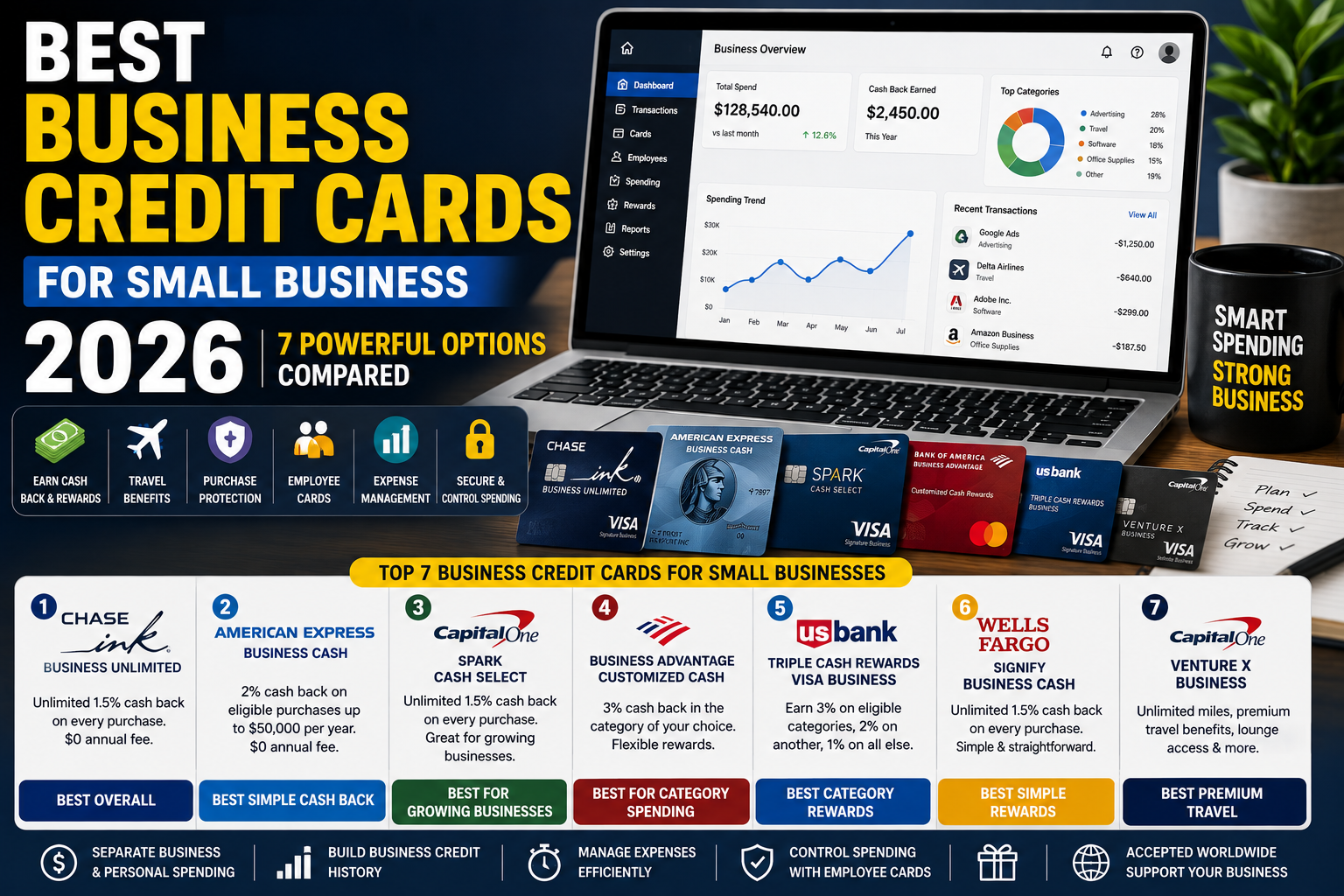
- Best Business Credit Cards for Small Business
- Chase Ink Business Unlimited
- American Express Blue Business Cash
- Capital One Spark Cash Select
- Bank of America Business Advantage Customized Cash
- U.S. Bank Triple Cash Rewards Visa Business
- Wells Fargo Signify Business Cash
- Capital One Venture X Business
- Business Credit Card Comparison
- Cash Back vs Travel Rewards
- Important Features to Compare
- Business Credit Cards for Different Businesses
- How Much Do Business Credit Cards Cost?
- Business Credit Cards vs Corporate Cards
- How Business Credit Cards Can Help With Expense Management
- Common Mistakes
- Frequently Asked Questions
- Final Verdict
What Is a Business Credit Card?
A business credit card is a payment card designed for business-related spending.
It can be used for expenses such as:
- Advertising
- Software subscriptions
- Office supplies
- Travel
- Hotels
- Business meals
- Equipment
- Shipping
- Online services
- Vendor purchases
Depending on the issuer, business cards may also provide tools for managing employee spending.
For example, a business owner might give employees individual cards while setting spending limits and monitoring transactions.
This can make expense tracking easier.
Why Small Businesses Use Business Credit Cards
A business credit card can provide several advantages when used responsibly.
Separate Business and Personal Spending
Keeping expenses separate can simplify bookkeeping and financial reporting.
Earn Rewards
Some cards offer:
- Cash back
- Points
- Miles
- Travel rewards
Manage Employee Spending
Many business cards support employee or additional cards and provide transaction monitoring.
For example, Chase says its Ink Business Unlimited card offers employee cards at no additional cost and allows businesses to monitor spending through purchase alerts, spending limits and reporting tools.
Improve Expense Tracking
Business-card transactions can be connected to accounting or expense-management systems.
Access Short-Term Payment Flexibility
A credit card may provide a payment window between the purchase and the payment due date.
However, carrying a balance can result in interest charges, so businesses should understand the card’s APR and terms before using it for financing.
Best Business Credit Cards for Small Business
The following seven cards represent different use cases.
| Card | Best For | Main Strength |
|---|---|---|
| Chase Ink Business Unlimited | Overall value | Unlimited flat-rate cash back |
| Amex Blue Business Cash | Simple cash back | 2% cash back up to annual threshold |
| Capital One Spark Cash Select | Growing businesses | Flat-rate cash rewards |
| Bank of America Business Advantage Customized Cash | Category spending | Flexible bonus categories |
| U.S. Bank Triple Cash Rewards Visa Business | Service businesses | Category-focused rewards |
| Wells Fargo Signify Business Cash | Simple cash back | Flat-rate business rewards |
| Capital One Venture X Business | Premium travel | Travel rewards and premium benefits |
Note: Card terms, rewards, introductory offers and eligibility requirements can change. Always verify the current issuer terms before applying.
1. Chase Ink Business Unlimited — Best Overall


5
Chase Ink Business Unlimited is designed for businesses that want a straightforward cash-back structure.
The current Chase offer lists:
- $0 annual fee
- Unlimited 1.5% cash back on every business purchase
- 0% introductory APR for 12 months on purchases
- A current welcome offer of up to $1,000 cash back after qualifying spending requirements.
Key Features
- Unlimited 1.5% cash back
- $0 annual fee
- Employee cards
- Spending controls
- Purchase alerts
- Expense reporting
- Accounting integrations
- Introductory APR
Best For
- Small businesses
- Freelancers
- Consultants
- Agencies
- Businesses with varied spending
Advantages
- Simple rewards
- No annual fee
- No complicated category tracking
- Employee-card support
- Strong business-management tools
Disadvantages
- Flat-rate rewards may be less valuable than category-specific cards for specialized spending
- U.S.-market product
Verdict: A strong all-purpose option for businesses that want simple cash back without an annual fee.
2. American Express Blue Business Cash — Best Simple Cash Back


4
American Express Blue Business Cash is designed around straightforward cash-back rewards.
The current American Express offer lists:
- $0 annual fee
- 2% cash back on eligible purchases up to $50,000 per calendar year
- 1% cash back after that threshold.
American Express also highlights expense-management tools and additional business services as part of the card ecosystem.
Key Features
- 2% cash back on eligible purchases up to annual threshold
- 1% after threshold
- $0 annual fee
- Expense-management tools
- Business services
- Flexible purchasing features
Best For
- Freelancers
- Consultants
- Small agencies
- Service businesses
- Businesses with moderate spending
Advantages
- Simple rewards
- No annual fee
- Easy-to-understand structure
- Business expense tools
Disadvantages
- Higher reward rate has an annual spending threshold
- Acceptance can vary outside the U.S.
Verdict: A compelling option for businesses that want simple cash back without paying an annual fee.
3. Capital One Spark Cash Select — Best for Growing Businesses


Capital One Business offers several business credit-card products aimed at different spending patterns.
Spark Cash Select is particularly relevant to businesses looking for a straightforward cash-back structure.
Key Features
Depending on the current product version and offer:
- Flat-rate cash rewards
- Business spending management
- Employee cards
- Account controls
- Expense tracking
- Introductory offers on eligible products
Best For
- Growing small businesses
- Businesses with varied expenses
- Companies wanting simple rewards
Advantages
- Straightforward rewards
- Business-focused features
- Spending-management tools
- Multiple business-card options
Disadvantages
- Exact rewards and terms depend on the specific Spark product
- Eligibility requirements apply
Verdict: Worth considering for businesses that want a flat-rate rewards structure and a broader business-card ecosystem.
4. Bank of America Business Advantage Customized Cash — Best for Category Spending


4
Bank of America Business Credit Cards include products designed around different business spending patterns.
The Business Advantage Customized Cash Rewards card is particularly interesting for businesses that spend heavily in selected categories.
Key Features
Depending on the current offer and terms:
- Category-based cash rewards
- Choice of spending categories
- Business expense management
- Employee cards
- Online account management
- Introductory offers
Best For
- Marketing-heavy businesses
- Service businesses
- Businesses with predictable spending categories
- Existing Bank of America customers
Advantages
- Category-focused rewards
- Business spending controls
- Flexible reward structure
- Banking ecosystem integration
Disadvantages
- Reward categories and caps can apply
- May require more tracking than a flat-rate card
Verdict: A good choice when your business spends heavily in categories that receive enhanced rewards.
5. U.S. Bank Triple Cash Rewards Visa Business — Best for Category Rewards


4
U.S. Bank Business Credit Cards offers several options for small and growing businesses.
The Triple Cash Rewards Visa Business is designed around business categories and cash-back rewards.
Key Features
- Category-based cash rewards
- Business spending tools
- Employee cards
- Expense tracking
- Introductory offers
- Business-management features
Best For
- Service businesses
- Businesses with recurring category spending
- Companies that want cash-back rewards
Advantages
- Category rewards
- Business-focused features
- Expense-management tools
Disadvantages
- Category rules apply
- U.S.-specific availability
Verdict: Worth comparing if your business spending fits its eligible reward categories.
6. Wells Fargo Signify Business Cash — Best Simple Rewards


4
Wells Fargo Business Credit Cards include cards designed for businesses seeking cash rewards and account-management features.
The Signify Business Cash card is positioned as a straightforward cash-back option.
Key Features
- Cash rewards
- Business expense tracking
- Employee cards
- Online account management
- Business spending tools
Best For
- Small businesses
- Freelancers
- Consultants
- Businesses preferring simple rewards
Advantages
- Straightforward cash-back approach
- Business expense management
- No complicated rewards categories on the core structure
Disadvantages
- U.S.-only product
- Current terms should be checked before application
Verdict: A useful option to compare when simplicity is more important than maximizing specialized reward categories.
7. Capital One Venture X Business — Best Premium Travel


4
Capital One Venture X Business is aimed at businesses that spend significantly on travel and want premium travel benefits.
It is very different from a basic no-fee cash-back card.
Key Features
- Travel rewards
- Premium travel benefits
- Airport lounge access
- Travel credits
- Business spending tools
- Employee cards
- Travel management features
Best For
- International businesses
- Frequent business travelers
- Executives
- Consulting companies
- Companies with high travel expenses
Advantages
- Premium travel benefits
- Strong travel-focused rewards
- Business travel features
- Potential value for frequent travelers
Disadvantages
- Premium annual fee
- Benefits are most valuable when actually used
- Requires careful comparison of travel value versus fees
Verdict: Better suited to businesses with substantial travel spending than companies looking for simple cash back.
Business Credit Card Comparison
| Card | Best For | Annual Fee | Reward Style | Travel Benefits | Best For Simple Spending |
|---|---|---|---|---|---|
| Chase Ink Business Unlimited | Overall | $0 | Flat cash back | ⭐⭐⭐ | ⭐⭐⭐⭐⭐ |
| Amex Blue Business Cash | Simple cash back | $0 | Cash back | ⭐⭐⭐ | ⭐⭐⭐⭐⭐ |
| Capital One Spark Cash Select | Growing SMB | Varies | Cash back | ⭐⭐⭐ | ⭐⭐⭐⭐ |
| Bank of America Customized Cash | Category spend | Varies | Category cash back | ⭐⭐⭐ | ⭐⭐⭐⭐ |
| U.S. Bank Triple Cash | Category rewards | Varies | Cash back | ⭐⭐⭐ | ⭐⭐⭐⭐ |
| Wells Fargo Signify | Simple rewards | Varies | Cash back | ⭐⭐⭐ | ⭐⭐⭐⭐⭐ |
| Capital One Venture X Business | Travel | Premium | Travel rewards | ⭐⭐⭐⭐⭐ | ⭐⭐⭐ |
Important: Annual fees, reward rates, introductory offers and benefit conditions can change. Always check the issuer’s current pricing and terms before applying.
Cash Back vs Travel Rewards
One of the biggest decisions when choosing a business credit card is deciding between cash back and travel rewards.
Cash Back Cards
Cash-back cards are generally straightforward.
For example:
$10,000 spending × 2% cash back = $200
The reward can potentially be used to offset business expenses.
Best For
- General business spending
- Software subscriptions
- Advertising
- Office expenses
- Vendor payments
- Businesses that don’t travel frequently
Travel Rewards Cards
Travel cards typically provide:
- Points
- Miles
- Airline benefits
- Hotel benefits
- Airport lounges
- Travel credits
They can potentially provide greater value if your business travels frequently.
Best For
- Consultants
- International businesses
- Sales teams
- Executives
- Businesses with regular flights and hotels
However, travel rewards can be more complicated to value than cash back.
Important Features to Compare
When searching for the best business credit cards for small business, don’t look only at the headline reward rate.
Consider the complete cost and benefit structure.
1. Annual Fee
Some cards charge no annual fee.
Others can cost hundreds of dollars per year.
A premium card can still be worthwhile if the benefits exceed the annual fee.
2. APR
If you plan to carry a balance, APR becomes extremely important.
A rewards card with a high interest rate may cost significantly more in interest than the rewards you earn.
For example:
If you carry $10,000 at a high interest rate, the interest expense can quickly exceed a few hundred dollars of annual rewards.
Paying the statement balance in full whenever practical can help avoid interest charges.
3. Reward Rate
Look at the actual spending categories.
For example:
- Advertising
- Travel
- Restaurants
- Office supplies
- Software
- Utilities
- General purchases
A 5% reward in a category you rarely use may be less valuable than 1.5% or 2% on all your actual spending.
4. Reward Caps
Some cards have annual or monthly limits.
For example, a card might offer:
2% cash back up to $50,000
and then a lower rate afterward.
American Express currently uses this type of structure on its Blue Business Cash card, with 2% cash back on eligible purchases up to $50,000 per calendar year and 1% thereafter.
5. Annual Fee Waiver
Some cards waive the annual fee if your business reaches a specific spending level.
Always calculate whether the spending requirement is realistic.
6. Foreign Transaction Fees
International businesses should pay close attention to foreign transaction fees.
A card with a high foreign transaction fee can reduce the value of rewards earned on overseas purchases.
7. Employee Cards
Employee cards can simplify business spending.
Look for:
- Free employee cards
- Spending limits
- Individual controls
- Purchase alerts
- Transaction reporting
8. Expense Management
Some business credit cards include:
- Expense categorization
- Receipt management
- Accounting integrations
- Employee spending controls
- Digital cards
These features can reduce finance-team workload.
9. Welcome Bonus
A welcome bonus can be valuable, but only if the required spending is realistic.
Never increase unnecessary business spending just to qualify for a bonus.
10. Purchase Protection and Travel Benefits
Depending on the card, businesses may receive benefits such as:
- Purchase protection
- Extended warranty
- Rental-car coverage
- Travel insurance
- Trip protection
- Airport lounge access
Always read the actual benefit terms and exclusions.
Business Credit Cards for Different Businesses
Freelancers
Freelancers generally benefit from simplicity.
Look for:
- $0 annual fee
- Flat-rate cash back
- Easy expense tracking
- No unnecessary complexity
A simple cash-back business card may be sufficient.
Agencies
Agencies often spend heavily on:
- Advertising
- Software
- Freelancers
- Travel
- Client expenses
A category-based rewards card may be attractive if its bonus categories match the agency’s actual spending.
E-Commerce Businesses
E-commerce companies may have significant:
- Advertising expenses
- Software costs
- Shipping
- Inventory
- Online services
Look for cards that reward the categories where most spending occurs.
Consulting Businesses
Consultants often spend on:
- Airfare
- Hotels
- Restaurants
- Software
- Client travel
A travel-rewards business card can make sense if travel spending is consistently high.
International Businesses
International companies should prioritize:
- Foreign transaction fees
- Multi-currency support
- International acceptance
- Travel benefits
- Employee spending
- Expense-management integrations
How Much Do Business Credit Cards Cost?
Business credit cards can range from $0 annual fee to premium cards costing hundreds of dollars per year.
The right card isn’t necessarily the cheapest.
Instead, calculate:
Annual Rewards + Benefits − Annual Fee − Interest − Other Fees
For example:
Suppose your company spends $100,000 per year and earns 2% cash back.
$100,000 × 2% = $2,000
If the annual fee is $200:
$2,000 − $200 = $1,800
But this assumes the business doesn’t carry a balance and that all spending qualifies for the advertised reward rate.
Business Credit Cards vs Corporate Cards
These terms are sometimes used interchangeably, but they can describe different products.
Business Credit Card
Usually designed for small-business owners and smaller companies.
It may offer:
- Rewards
- Cash back
- Travel benefits
- Employee cards
Corporate Card
Usually designed for larger companies.
It may offer:
- Higher spending controls
- Centralized billing
- Detailed expense management
- Multiple employee cards
- Procurement integration
- Advanced reporting
For a small business with a few employees, a business credit card may be enough.
For a company with hundreds of employees, a corporate-card or spend-management platform may be more appropriate.
How Business Credit Cards Can Help With Expense Management
A business card can become part of a larger finance workflow.
For example:
Employee Purchase → Card Transaction → Receipt → Expense System → Approval → Accounting
This can reduce manual data entry.
Some issuers also provide tools for spending limits and reporting.
Chase, for example, highlights purchase alerts, employee spending limits and reporting tools for its Ink Business cards.
Common Mistakes
Mistake 1: Choosing the Highest Reward Rate
A high advertised reward rate doesn’t necessarily mean the highest real-world value.
Always examine:
- Spending category
- Reward cap
- Annual fee
- Redemption value
Mistake 2: Carrying a Balance for Rewards
Interest can easily exceed the rewards earned.
Rewards should not be an excuse to spend beyond the business’s ability to repay.
Mistake 3: Ignoring Annual Fees
A premium card only makes sense if your business can use enough of its benefits.
Mistake 4: Missing Reward Caps
Read the terms carefully.
A reward rate may apply only up to a certain spending threshold.
Mistake 5: Using Personal Cards for Everything
Mixing personal and business transactions can make bookkeeping more complicated.
Mistake 6: Giving Employees Unlimited Spending
Use spending limits where the issuer provides them.
Mistake 7: Chasing Welcome Bonuses
Don’t make unnecessary purchases simply to meet a sign-up requirement.
Mistake 8: Ignoring Foreign Transaction Fees
International businesses can lose a significant amount through transaction fees.
Frequently Asked Questions
What is the best business credit card for small business?
There is no universal winner.
A flat-rate cash-back card can be ideal for general spending, while a category-rewards card may be better for businesses with concentrated spending. Travel-focused cards can be more valuable for companies with frequent business travel.
Are business credit cards worth it?
They can be, particularly when a business uses the card to separate expenses, simplify bookkeeping and earn rewards without carrying expensive balances.
Can a freelancer get a business credit card?
In markets where business cards are available to sole proprietors, freelancers may qualify depending on the issuer’s requirements.
Eligibility varies by country and issuer.
Can employees have business credit cards?
Many business-card issuers offer additional employee cards.
The availability, fees and spending controls vary by card.
Do business credit cards help build business credit?
Some business cards can contribute to business credit history, but reporting policies vary by issuer.
Check the issuer’s reporting practices before applying.
Is cash back better than travel rewards?
It depends on the business.
Cash back is simpler.
Travel rewards can potentially provide more value if your company travels frequently and can use the benefits.
Should a small business carry a credit-card balance?
Businesses should understand the interest costs before carrying a balance.
If interest charges exceed the rewards earned, the rewards strategy may not be financially beneficial.
What is a good business credit-card reward rate?
There is no single rate that is best for every business.
A 1.5% flat reward can sometimes outperform a higher category-specific reward if most of your spending falls outside the bonus categories.
Are business credit cards available in every country?
Yes, many countries have business and corporate-card products, but the specific cards and rules vary significantly.
The examples in this article are primarily U.S. products.
How should I choose a business credit card?
Start with your spending.
Calculate how much your business spends on:
- Advertising
- Travel
- Software
- Supplies
- Restaurants
- Utilities
- General purchases
Then compare cards based on those actual spending patterns.
Final Verdict
The best business credit cards for small business depend on your spending habits rather than a single universal ranking.
Choose Chase Ink Business Unlimited
If you want simple flat-rate cash back and no annual fee. Chase currently lists unlimited 1.5% cash back on business purchases.
Choose American Express Blue Business Cash
If you want straightforward cash back with a $0 annual fee and 2% cash back on eligible purchases up to the current annual threshold.
Choose Capital One Spark Cash Select
If you want a business-focused cash-back option from a major issuer.
Choose Bank of America Business Advantage Customized Cash
If your spending is concentrated in categories where enhanced rewards are available.
Choose U.S. Bank Triple Cash Rewards
If your business can take advantage of its category-based reward structure.
Choose Wells Fargo Signify Business Cash
If simplicity and straightforward cash rewards are your priority.
Choose Capital One Venture X Business
If your company spends heavily on travel and can justify a premium card.
Before applying, compare:
Annual Fee + APR + Rewards + Reward Caps + Foreign Transaction Fees + Employee Cards + Travel Benefits + Expense Controls
The best card is not necessarily the one advertising the highest reward rate.
The best card is the one that matches your actual business spending and provides more value than it costs.