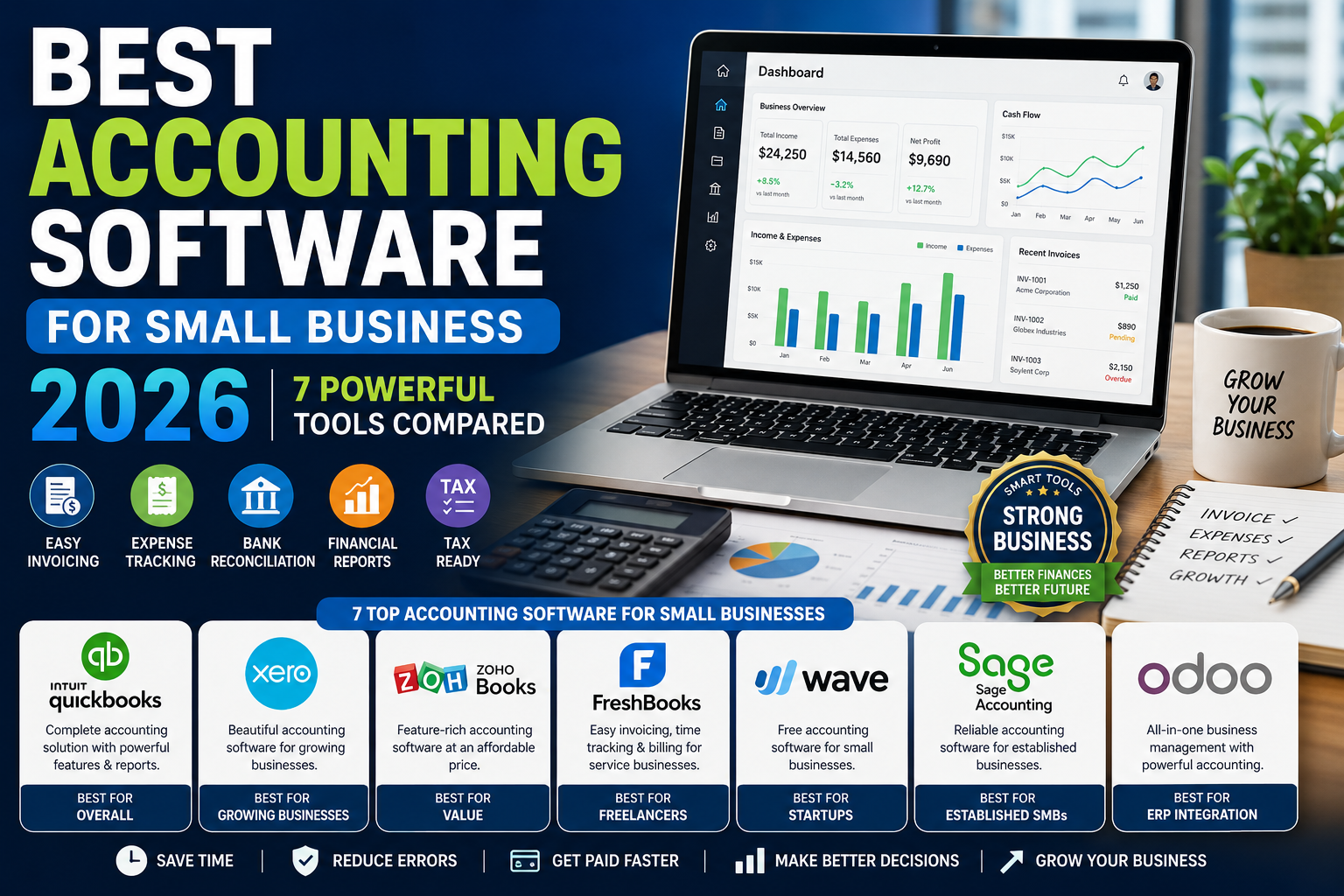
Best Accounting Software for Small Business in 2026: 7 Powerful Tools Compared
Managing finances is one of the most important responsibilities for any small business owner.
Invoices, expenses, payments, taxes, payroll and cash flow can quickly become difficult to manage when everything is tracked manually.
That’s where accounting software can make a major difference.
The best accounting software for small business can automate bookkeeping, create invoices, track expenses, reconcile bank transactions and generate financial reports.
In this guide, we’ll compare 7 popular accounting platforms in 2026 and explain which type of business each one is best suited for.
Table of Contents
- What Is Accounting Software?
- Why Small Businesses Need Accounting Software
- Best Accounting Software for Small Business
- QuickBooks Online
- Xero
- Zoho Books
- FreshBooks
- Wave
- Sage Accounting
- Odoo
- Comparison Table
- Important Features to Look For
- Cloud vs Desktop Accounting
- Accounting Software for Different Businesses
- How Much Does Accounting Software Cost?
- Accounting Software vs Excel
- Common Mistakes
- Frequently Asked Questions
- Final Verdict
What Is Accounting Software?
Accounting software is a digital platform that helps businesses manage financial transactions and accounting records.
Instead of manually maintaining spreadsheets, businesses can use software to organize:
- Sales
- Purchases
- Invoices
- Expenses
- Payments
- Bank transactions
- Accounts receivable
- Accounts payable
- Taxes
- Financial reports
- Cash flow
More advanced platforms can also connect accounting with:
- CRM
- Payroll
- Inventory
- E-commerce
- Payment processors
- Banking
- Project management
The goal is to make financial management faster, more accurate and easier to understand.
Why Small Businesses Need Accounting Software
A new business may be able to manage its finances using Excel or Google Sheets.
But as transaction volume increases, spreadsheets can become difficult to maintain.
For example, a growing business might have:
- 300 invoices per month
- 50 suppliers
- Multiple bank accounts
- Recurring expenses
- Online payments
- International customers
- Employee expenses
Manually tracking all of this can consume valuable time.
Accounting software can centralize the information and automate repetitive tasks.
Main Benefits
Save Time: Automate repetitive bookkeeping.
Reduce Errors: Reduce manual calculations and duplicate data entry.
Track Cash Flow: See money coming in and going out.
Get Paid Faster: Send invoices and payment reminders.
Improve Reporting: Generate financial reports quickly.
Work With Accountants: Give accountants controlled access.
Scale Faster: Add automation and integrations as the business grows.
Recent 2026 comparisons continue to highlight invoicing, expense tracking, bank reconciliation, accounts payable/receivable and financial reporting as core requirements for small-business accounting software.
Best Accounting Software for Small Business
There are many accounting platforms available globally.
For 2026, these seven are worth considering:
| Software | Best For | Main Strength |
|---|---|---|
| QuickBooks Online | Overall small business | Complete accounting ecosystem |
| Xero | Growing businesses | Collaboration & integrations |
| Zoho Books | Value-conscious businesses | Features & automation |
| FreshBooks | Freelancers | Invoicing & time tracking |
| Wave | Very small businesses | Free core accounting |
| Sage Accounting | Established SMBs | Financial management |
| Odoo | Growing companies | ERP + accounting |
The right choice depends on your business model, country, accounting requirements, number of users and budget.
1. QuickBooks Online — Best Overall


6
QuickBooks Online official website is one of the most established cloud accounting platforms for small businesses.
It combines bookkeeping, invoicing, expenses, financial reporting and other business-finance functions.
Key Features
- Invoicing
- Expense tracking
- Bank connections
- Bank reconciliation
- Profit and loss reports
- Balance sheet
- Cash-flow reports
- Accounts receivable
- Accounts payable
- Payment processing
- Payroll integrations
- Mobile applications
- Financial reporting
Best For
QuickBooks can be a good option for:
- Small businesses
- Agencies
- Consultants
- E-commerce businesses
- Professional services
- Growing companies
Advantages
- Mature accounting ecosystem
- Large integration marketplace
- Strong reporting
- Accountant collaboration
- Broad feature set
Disadvantages
- Costs can increase with additional users and features
- Advanced functionality may require higher plans
Verdict: One of the strongest all-around choices for a small business looking for a mature accounting platform.
2. Xero — Best for Growing Businesses


6
Xero official website is a cloud accounting platform used by businesses in many markets.
Xero places significant emphasis on collaboration, bank reconciliation and integrations.
Key Features
- Online invoicing
- Bank reconciliation
- Expense management
- Bills
- Purchase orders
- Financial reports
- Cash-flow management
- Inventory
- Multi-currency
- Project tracking
- Mobile applications
- Business integrations
Best For
- Growing businesses
- International businesses
- Agencies
- E-commerce companies
- Professional services
- Businesses working closely with accountants
Advantages
- Cloud-based
- Strong integrations
- Multi-currency capabilities
- Good collaboration
- Modern interface
Disadvantages
- Pricing varies by market
- Some features are restricted to higher plans
Verdict: An excellent option for growing companies and businesses that need strong collaboration and integrations.
3. Zoho Books — Best Value


6
Zoho Books official website is a cloud accounting platform that combines accounting, invoicing, expenses and business automation.
It is especially attractive for businesses already using other Zoho products.
Key Features
- Invoicing
- Expense tracking
- Bank reconciliation
- Accounts receivable
- Accounts payable
- Inventory
- Purchase orders
- Sales orders
- Financial reports
- Multi-currency
- Customer portal
- Payment reminders
- Automation
- Mobile applications
Zoho provides localized editions for different markets, so tax features, plans and pricing can vary by country.
Best For
- Startups
- Agencies
- Freelancers
- SaaS companies
- E-commerce businesses
- Service businesses
Advantages
- Strong feature-to-price ratio
- Cloud-based
- Good automation
- Modern interface
- Large software ecosystem
Disadvantages
- Advanced features require higher plans
- Tax functionality differs by country
Verdict: One of the strongest choices for businesses wanting broad accounting functionality without moving to expensive enterprise software.
4. FreshBooks — Best for Freelancers


6
FreshBooks official website focuses heavily on freelancers, consultants, agencies and service businesses.
Its invoicing and time-tracking features make it particularly useful for businesses that bill clients for hours or projects.
Key Features
- Invoicing
- Online payments
- Expense tracking
- Time tracking
- Project management
- Estimates
- Recurring invoices
- Client management
- Financial reports
- Accounting integrations
Best For
- Freelancers
- Consultants
- Agencies
- Designers
- Developers
- Professional services
Advantages
- Easy to use
- Strong invoicing
- Time tracking
- Client-friendly workflows
- Project functionality
Disadvantages
- Not ideal for complex inventory
- Larger businesses may need more advanced accounting capabilities
Verdict: An excellent choice for freelancers and service-based businesses where invoicing and time tracking are important.
5. Wave — Best Free Option


5
Wave official website is designed for small businesses, freelancers and entrepreneurs.
Its free accounting offering makes it attractive for businesses with simple financial requirements.
Key Features
- Income tracking
- Expense tracking
- Invoicing
- Financial reports
- Receipt management
- Bank connections
- Customer management
Wave’s availability and specific services vary by country, so businesses should verify whether the current offering supports their location before choosing it.
Best For
- Freelancers
- Solo entrepreneurs
- Very small businesses
- Early-stage businesses
Advantages
- Free core accounting in supported markets
- Simple interface
- Easy invoicing
- Suitable for small operations
Disadvantages
- Country availability varies
- Less suitable for complex accounting
- Advanced requirements may require other software
Verdict: A compelling choice for eligible micro-businesses that want simple accounting without a monthly software subscription.
6. Sage Accounting — Best for Established SMBs


6
Sage official website provides accounting and financial-management solutions for small and medium-sized businesses.
The Sage ecosystem includes accounting, payroll and broader financial-management products.
Key Features
- Invoicing
- Bank feeds
- Expense management
- Cash-flow management
- Financial reports
- Accounts payable
- Accounts receivable
- Inventory on supported products
- Payroll integrations
Best For
- Established SMBs
- Growing companies
- Businesses working with accountants
- Businesses needing broader financial-management tools
Advantages
- Established accounting provider
- Broad financial ecosystem
- Strong reporting
- Multiple business products
Disadvantages
- Product selection can be confusing
- Features and pricing vary by country
Verdict: Worth considering for established businesses that need more than basic invoicing and bookkeeping.
7. Odoo Accounting — Best for ERP Integration


5
Odoo official website takes a broader approach to business software.
Instead of focusing only on accounting, Odoo can connect accounting with many other business functions.
For example:
- CRM
- Sales
- Inventory
- Purchasing
- Manufacturing
- HR
- Projects
- Website
- E-commerce
Key Features
- Accounting
- Invoicing
- Bank synchronization
- Financial reporting
- Accounts payable
- Accounts receivable
- Inventory
- CRM integration
- Sales integration
- Purchasing
- Multi-company
- Multi-currency
Best For
- Growing companies
- Distributors
- Manufacturers
- E-commerce businesses
- Companies wanting ERP functionality
Advantages
- Accounting + CRM + inventory
- Large application ecosystem
- Highly customizable
- Strong business-process integration
Disadvantages
- More complex than standalone accounting software
- Implementation may require planning
Verdict: An excellent choice when accounting needs to connect with the rest of the business.
Accounting Software Comparison
| Feature | QuickBooks | Xero | Zoho Books | FreshBooks | Wave | Sage | Odoo |
|---|---|---|---|---|---|---|---|
| Invoicing | ⭐⭐⭐⭐⭐ | ⭐⭐⭐⭐⭐ | ⭐⭐⭐⭐⭐ | ⭐⭐⭐⭐⭐ | ⭐⭐⭐⭐ | ⭐⭐⭐⭐ | ⭐⭐⭐⭐⭐ |
| Bookkeeping | ⭐⭐⭐⭐⭐ | ⭐⭐⭐⭐⭐ | ⭐⭐⭐⭐⭐ | ⭐⭐⭐⭐ | ⭐⭐⭐ | ⭐⭐⭐⭐⭐ | ⭐⭐⭐⭐⭐ |
| Bank Reconciliation | ✅ | ✅ | ✅ | ✅ | ✅ | ✅ | ✅ |
| Expense Tracking | ✅ | ✅ | ✅ | ✅ | ✅ | ✅ | ✅ |
| Inventory | ⭐⭐⭐⭐ | ⭐⭐⭐⭐ | ⭐⭐⭐⭐ | ⭐⭐ | ⭐⭐ | ⭐⭐⭐⭐ | ⭐⭐⭐⭐⭐ |
| Time Tracking | ⭐⭐⭐ | ⭐⭐⭐ | ⭐⭐⭐ | ⭐⭐⭐⭐⭐ | ⭐⭐ | ⭐⭐⭐ | ⭐⭐⭐⭐ |
| Multi-Currency | ✅ | ✅ | ✅ | ✅ | Limited | ✅ | ✅ |
| CRM Integration | ⭐⭐⭐ | ⭐⭐⭐ | ⭐⭐⭐⭐ | ⭐⭐⭐ | ⭐⭐ | ⭐⭐⭐ | ⭐⭐⭐⭐⭐ |
| Best For | Overall | Growing SMB | Value | Services | Micro-business | Established SMB | ERP |
Note: Features can vary by plan, country and product edition. The ratings are editorial comparisons, not independent benchmark scores.
Important Features to Look For
When choosing the best accounting software for small business, don’t simply choose the platform with the longest feature list.
Focus on the features your business actually needs.
1. Invoicing
Look for:
- Professional invoices
- Recurring invoices
- Payment links
- Invoice reminders
- Invoice status
- Estimates and quotes
2. Expense Tracking
Your software should make it easy to record:
- Office expenses
- Advertising
- Travel
- Software subscriptions
- Equipment
- Utilities
- Professional services
Receipt scanning can make expense recording much faster.
3. Bank Reconciliation
Bank reconciliation matches accounting records with actual bank transactions.
It can help identify:
- Missing transactions
- Duplicate entries
- Incorrect amounts
- Bank fees
- Unrecorded payments
4. Accounts Receivable
Accounts receivable tracks money customers owe the business.
A useful workflow is:
Invoice → Due Date → Reminder → Payment → Reconciliation
This can help businesses improve cash collection.
5. Accounts Payable
Accounts payable tracks money the business owes suppliers.
It can help prevent:
- Missed bills
- Late payments
- Duplicate payments
- Unexpected cash-flow problems
6. Financial Reports
At minimum, look for:
- Profit & Loss
- Balance Sheet
- Cash Flow
- Accounts Receivable
- Accounts Payable
- Sales reports
- Expense reports
7. Tax Support
Tax requirements differ from country to country.
Depending on your location, you may need support for:
- VAT
- GST
- Sales tax
- Payroll taxes
- Corporate taxes
- Tax reports
- Digital invoicing
Always verify that the software supports your specific jurisdiction.
Cloud vs Desktop Accounting
Cloud Accounting
Cloud accounting allows financial data to be accessed through the internet.
Advantages
- Access from anywhere
- Easier collaboration
- Automatic software updates
- Mobile applications
- Easier accountant access
- Integrations with online services
Disadvantages
- Recurring subscription
- Internet access is generally required
- Data is hosted by the provider
Desktop Accounting
Desktop software is installed on a local computer or business server.
Advantages
- Local control
- Can work without continuous internet
- Familiar workflow for many businesses
- Useful for certain specialized environments
Disadvantages
- Backups require more planning
- Remote access can be harder
- Updates may be manual
- Collaboration can be more complicated
Which One Is Better?
For many new small businesses, cloud accounting is the more convenient option.
However, businesses with specialized workflows may still prefer desktop or hybrid accounting.
Accounting Software for Different Businesses
Freelancers
Prioritize:
- Invoicing
- Time tracking
- Expenses
- Client management
- Payment collection
FreshBooks can be a strong choice.
Agencies
Look for:
- Client invoicing
- Time tracking
- Project profitability
- Recurring invoices
- Expenses
FreshBooks, QuickBooks and Zoho Books are worth comparing.
E-Commerce Businesses
Prioritize:
- Inventory
- Payment integrations
- Refunds
- Multiple sales channels
- Tax reporting
- Cost of goods sold
QuickBooks, Xero, Zoho Books and Odoo can be considered.
Retail Businesses
Look for:
- Inventory
- Point-of-sale integrations
- Purchase management
- Sales tracking
- Payment reconciliation
The right choice depends on your POS and inventory requirements.
Manufacturers
Manufacturers usually need more than basic bookkeeping.
Look for:
- Inventory
- Purchasing
- Production
- Bill of materials
- Cost accounting
- Warehouse management
Odoo can be particularly useful when accounting needs to connect directly with manufacturing operations.
International Businesses
Prioritize:
- Multi-currency
- Multi-company
- International payments
- Local tax support
- Consolidated reporting
Xero, QuickBooks, Zoho Books and Odoo can all be considered depending on the countries involved.
How Much Does Accounting Software Cost?
Pricing varies significantly between providers.
Common pricing models include:
- Free plans
- Monthly subscriptions
- Annual subscriptions
- Per-user pricing
- Tiered plans
- Custom enterprise pricing
Current 2026 comparisons show substantial variation: QuickBooks, Xero and FreshBooks use tiered subscription models, while Wave offers free core accounting in supported markets and Zoho Books offers multiple plan levels.
Before Buying, Check:
- Number of users
- Invoice limits
- Bank connections
- Inventory
- Payroll
- Payment-processing fees
- Multi-currency
- Integrations
- Accountant access
- Customer support
- Data export
The cheapest monthly plan is not always the cheapest overall solution.
Accounting Software vs Excel
| Feature | Excel | Accounting Software |
|---|---|---|
| Invoicing | Manual | ✅ |
| Expense Tracking | Manual | ✅ |
| Bank Reconciliation | Manual | ✅ |
| Financial Reports | Manual | ✅ |
| Payment Reminders | Manual | ✅ |
| Recurring Invoices | Manual | ✅ |
| Tax Reports | Manual | ✅ |
| Multi-user Collaboration | Limited | ✅ |
| Automation | Limited | ✅ |
| Audit Trail | Limited | ✅ |
Excel remains useful for custom analysis.
However, dedicated accounting software is generally better suited to maintaining the primary financial records of a growing business.
Common Accounting Mistakes
Mistake 1: Mixing Personal and Business Expenses
Keep personal and business transactions separate.
This makes financial reporting and tax preparation easier.
Mistake 2: Not Reconciling Bank Accounts
Regular reconciliation helps identify missing or incorrect transactions.
Mistake 3: Ignoring Overdue Invoices
A business can be profitable on paper but still experience cash-flow problems if customers don’t pay on time.
Mistake 4: Forgetting Recurring Expenses
Software subscriptions and recurring services can gradually become a significant expense.
Mistake 5: Not Backing Up Data
Understand how your accounting provider handles backups and data exports.
Mistake 6: Giving Everyone Full Access
Use role-based permissions wherever possible.
Mistake 7: Choosing Software That Is Too Complicated
A five-person service business doesn’t necessarily need an enterprise ERP.
Choose software based on your current requirements and realistic growth plans.
Frequently Asked Questions
What is the best accounting software for small business?
QuickBooks Online is a strong overall option, while Xero is attractive for growing businesses, Zoho Books offers strong value, FreshBooks is particularly suited to service businesses, Wave is useful for eligible micro-businesses and Odoo is a good choice when accounting needs to integrate with broader business operations. Current 2026 comparisons similarly place QuickBooks, Xero, Wave, FreshBooks and Zoho Books among the leading small-business accounting platforms.
What is the easiest accounting software for a small business?
FreshBooks, Wave and Zoho Books can be good starting points for businesses with relatively simple accounting requirements.
Is QuickBooks good for small businesses?
Yes. QuickBooks provides invoicing, expenses, bank reconciliation, reporting and other accounting functions designed for small businesses.
Is Xero better than QuickBooks?
Neither is universally better. Xero can be attractive for collaboration and growing businesses, while QuickBooks has a broad ecosystem and extensive accountant support.
Is Zoho Books good for small businesses?
Yes. Zoho Books combines accounting, invoicing, expenses, banking, inventory and automation. Its features and tax functionality vary by country.
Is Wave accounting really free?
Wave offers free core accounting in supported markets, although some services and payment features can have separate fees. Availability varies by location.
Can accounting software replace an accountant?
Accounting software can automate bookkeeping and reporting, but it does not replace professional accounting judgment, tax planning or compliance advice.
Should a small business use cloud accounting?
For many businesses, yes. Cloud accounting can simplify collaboration, remote access, integrations and software updates.
Can accounting software handle multiple currencies?
Many modern accounting platforms support multi-currency accounting, although the exact functionality depends on the provider, plan and country.
Can accounting software manage taxes?
Many platforms can calculate or organize tax-related information and generate reports. However, tax rules vary by jurisdiction, so businesses should verify local requirements.
Final Verdict
The best accounting software for small business depends on your business model, location, budget and future growth.
Choose QuickBooks Online
If you want a mature, comprehensive accounting ecosystem.
Choose Xero
If collaboration, integrations and international operations are important.
Choose Zoho Books
If you want strong features, automation and good value.
Choose FreshBooks
If you’re a freelancer, consultant or service business focused heavily on invoicing and time tracking.
Choose Wave
If you’re an eligible micro-business looking for free core accounting.
Choose Sage
If you want an established financial-management platform for a growing business.
Choose Odoo
If accounting needs to connect with CRM, inventory, manufacturing, sales and other business operations.
Before selecting a platform, compare:
Price + Features + Local Tax Support + Integrations + Ease of Use + Scalability
Don’t choose accounting software simply because it has the lowest monthly price.
The right platform should help you answer important questions quickly:
How much did we sell?
How much did we spend?
Who owes us money?
Who do we owe money to?
Are we profitable?
How much cash do we have?
What will our financial position look like next month?
When accounting software can answer these questions accurately, it becomes more than bookkeeping software.
It becomes a financial decision-making tool for your business.