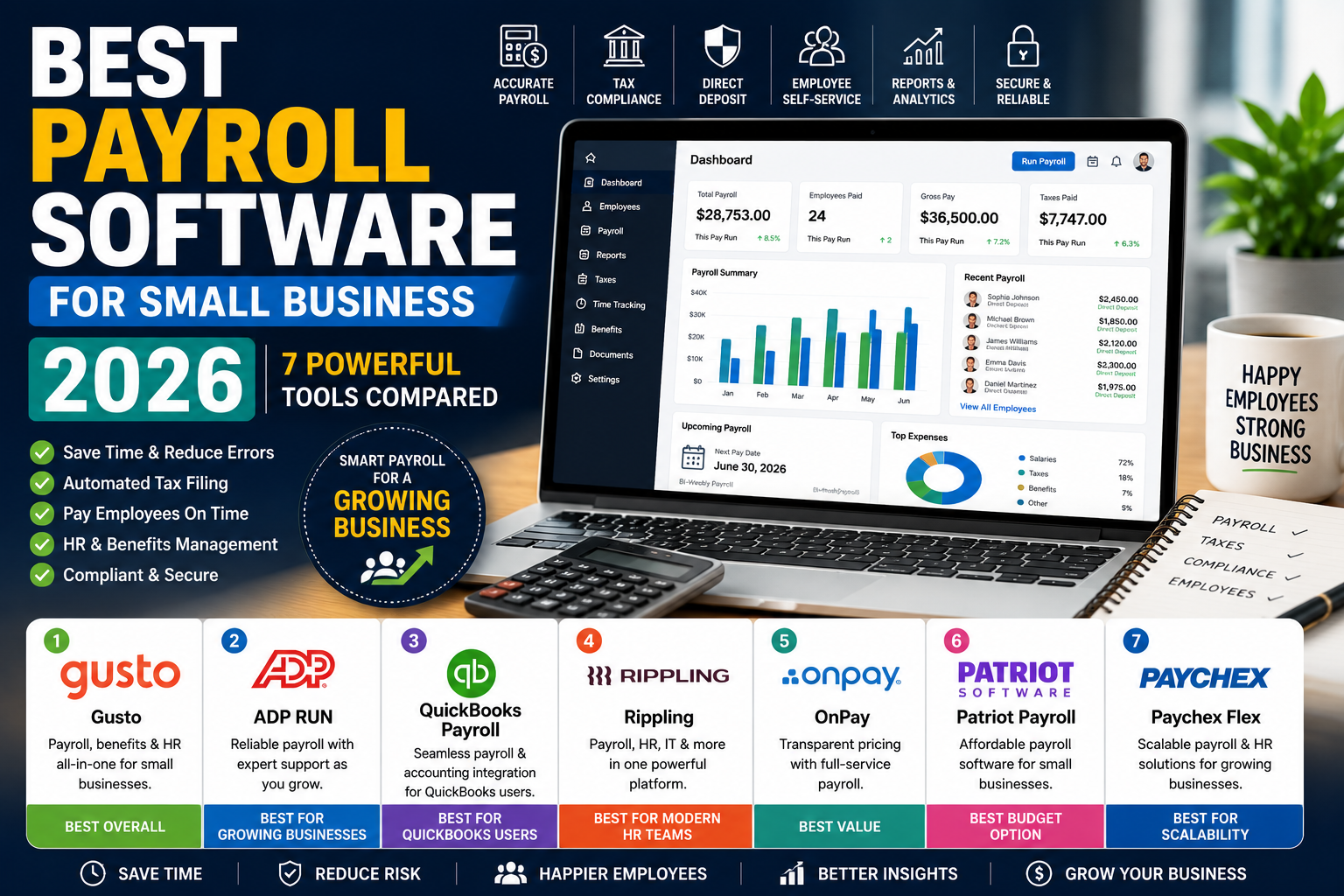
Best Payroll Software for Small Business in 2026: 7 Powerful Tools Compared
Running payroll is one of the most important responsibilities for any business with employees.
Every pay cycle requires accurate calculations, deductions, payments, records and tax-related tasks.
As a business grows, payroll can quickly become complicated.
You may need to manage:
- Employee salaries
- Hourly wages
- Overtime
- Bonuses
- Paid time off
- Employee deductions
- Payroll taxes
- Benefits
- Contractors
- Direct deposits
- Payslips
- Year-end tax forms
This is where payroll software can help.
The best payroll software for small business can automate payroll calculations, payments, tax filing, employee records and HR tasks.
In this guide, we’ll compare 7 powerful payroll platforms in 2026 and explain which type of business each one is best suited for.
Table of Contents
- What Is Payroll Software?
- Why Small Businesses Need Payroll Software
- Best Payroll Software for Small Business
- Gusto
- ADP RUN
- QuickBooks Payroll
- Rippling
- OnPay
- Patriot Payroll
- Paychex Flex
- Payroll Software Comparison
- Important Payroll Features
- Payroll Software for Different Businesses
- Cloud Payroll vs Manual Payroll
- How Much Does Payroll Software Cost?
- Payroll Software vs Spreadsheets
- Common Payroll Mistakes
- Frequently Asked Questions
- Final Verdict
What Is Payroll Software?
Payroll software is a digital platform that helps businesses calculate and process employee compensation.
Instead of calculating payroll manually, businesses can use software to automate many payroll-related tasks.
Depending on the platform, payroll software can manage:
- Employee salaries
- Hourly wages
- Overtime
- Bonuses
- Deductions
- Payroll taxes
- Direct deposits
- Payslips
- Employee benefits
- Paid time off
- Contractor payments
- Tax forms
- Payroll reports
Modern payroll platforms increasingly combine payroll with:
- HR
- Time tracking
- Benefits
- Employee onboarding
- Performance management
- Compliance
- Accounting
The goal is simple:
Pay employees accurately and on time while reducing administrative work.
Why Small Businesses Need Payroll Software
Payroll can become difficult when a business starts hiring employees.
Imagine a company with:
- 25 employees
- 5 hourly workers
- 20 salaried employees
- Multiple pay rates
- Overtime
- Paid leave
- Benefits
- Bonuses
- Different tax requirements
Calculating everything manually can introduce errors.
Payroll software can automate much of the process.
Main Benefits
Save Time
Automate repetitive payroll calculations and administrative tasks.
Reduce Errors
Software can reduce manual calculations and data-entry mistakes.
Automate Tax Tasks
Many full-service payroll platforms calculate, file and pay applicable payroll taxes in supported jurisdictions.
Pay Employees Faster
Direct deposit can make payroll distribution easier.
Improve Employee Experience
Employees can access payslips, tax documents and personal information through self-service portals.
Simplify HR
Some payroll platforms include onboarding, time tracking, benefits and employee-management tools.
Improve Compliance
Payroll providers can help businesses keep up with changing payroll requirements, although businesses remain responsible for choosing appropriate services and complying with applicable laws.
Best Payroll Software for Small Business
For 2026, these seven platforms are worth comparing:
| Payroll Software | Best For | Main Strength |
|---|---|---|
| Gusto | Small businesses | Payroll + HR simplicity |
| ADP RUN | Growing businesses | Payroll + expert support |
| QuickBooks Payroll | QuickBooks users | Accounting integration |
| Rippling | Modern HR teams | Payroll + HR + IT |
| OnPay | Value-conscious businesses | Transparent pricing |
| Patriot Payroll | Budget-focused businesses | Affordable payroll |
| Paychex Flex | Growing SMBs | Payroll + HR scalability |
Payroll features, pricing and country availability vary considerably, so businesses should verify current local functionality before choosing a provider.
1. Gusto — Best Overall


5
Gusto is a popular payroll and HR platform designed primarily for small and growing businesses.
Its platform combines payroll with HR, benefits and employee-management tools.
Gusto’s current published pricing includes a Simple plan at $49/month + $6 per person, while the Plus plan is listed at $80/month + $12 per person. Its Premium plan is listed at $180/month + $22 per person.
Key Features
- Full-service payroll
- Direct deposit
- Payroll tax filing
- Employee self-service
- Benefits administration
- PTO management
- Time tracking
- Hiring and onboarding
- Contractor payments
- Payroll reports
- HR tools
Best For
- Startups
- Small businesses
- Agencies
- Professional services
- Remote companies
- Growing businesses
Advantages
- Easy to use
- Payroll + HR in one platform
- Transparent pricing
- Employee self-service
- Benefits integration
- Modern interface
Disadvantages
- Primarily focused on supported markets
- Advanced HR features require higher plans
- Costs increase as employee count grows
Verdict: One of the strongest choices for a small business looking for simple payroll combined with HR functionality.
2. ADP RUN — Best for Growing Businesses


5
ADP RUN is designed specifically for small businesses.
ADP offers several RUN packages ranging from basic payroll to broader payroll and HR services. Its Essential Payroll package focuses on payroll, taxes and compliance, while higher packages add HR support and other capabilities.
Key Features
- Payroll processing
- Payroll tax calculations
- Tax filing
- Direct deposit
- Employee self-service
- HR tools
- Time and attendance
- Benefits integrations
- Payroll reports
- Compliance support
ADP says RUN supports payroll and HR needs for more than 900,000 small businesses.
Best For
- Growing businesses
- Professional services
- Retail businesses
- Companies wanting payroll support
- Businesses that expect to add HR functionality
Advantages
- Established payroll provider
- Strong payroll infrastructure
- Tax administration
- HR services
- Multiple support options
- Scalable packages
Disadvantages
- Pricing generally requires a quote
- Advanced options can increase costs
- May be more than a very small business needs
Verdict: A strong choice for businesses that want payroll now and the ability to add broader HR services later.
3. QuickBooks Payroll — Best for QuickBooks Users


5
QuickBooks Payroll is particularly attractive to businesses already using QuickBooks for accounting.
Having payroll and accounting in the same ecosystem can reduce duplicate data entry.
Key Features
- Payroll processing
- Direct deposit
- Payroll tax calculations
- Tax filing
- Employee self-service
- Payroll reports
- Time tracking integrations
- Benefits integrations
- Accounting integration
QuickBooks’ payroll products and pricing vary by plan and product edition. Intuit’s latest 2026 update also shows changes to its QuickBooks Desktop Payroll products, including a move of Basic and Standard users to Enhanced Payroll.
Best For
- QuickBooks users
- Small businesses
- Accountants
- Professional services
- Businesses wanting accounting + payroll integration
Advantages
- Strong accounting integration
- Familiar ecosystem
- Payroll reporting
- Direct deposit
- Employee tools
Disadvantages
- Best value may depend on already using QuickBooks
- Payroll pricing varies by product
- Some advanced capabilities require additional services
Verdict: An excellent option if your business already uses QuickBooks for accounting.
4. Rippling — Best for Payroll + HR + IT


6
Rippling takes a broader approach to employee management.
Instead of treating payroll as a standalone system, Rippling can connect payroll with HR and IT workflows.
Key Features
- Payroll
- Employee onboarding
- Benefits
- Time tracking
- HR management
- Device management
- App management
- Employee data
- Workflow automation
- Reporting
- Global workforce management
Best For
- Technology companies
- Startups
- Growing businesses
- Remote teams
- Companies with complex HR workflows
Advantages
- Payroll + HR + IT
- Strong automation
- Employee onboarding
- Workflow management
- Centralized employee information
Disadvantages
- Can be more complex than basic payroll software
- Pricing depends on selected modules
- May be unnecessary for very small teams
Verdict: A powerful choice for companies that want payroll connected to broader employee and technology management.
5. OnPay — Best Value


4
OnPay focuses on payroll, HR and employee benefits for small businesses.
OnPay currently lists payroll starting at $49/month + $6 per worker, with tax filings and payments included in its core payroll offering.
Key Features
- Full-service payroll
- W-2 and 1099 payments
- Tax filings
- Direct deposit
- Employee self-service
- Hiring and onboarding
- HR tools
- Benefits
- Workers’ compensation
- Reporting
- Accounting integrations
Best For
- Small businesses
- Startups
- Professional services
- Healthcare businesses
- Nonprofits
- Growing companies
Advantages
- Transparent pricing
- Full-service payroll
- HR functionality
- Benefits integrations
- Good support
- Unlimited pay runs
Disadvantages
- Core service is primarily focused on supported U.S. payroll requirements
- Advanced HR tools cost extra
Verdict: One of the strongest value-oriented options for small businesses that want payroll and basic HR capabilities.
6. Patriot Payroll — Best Budget Option


6
Patriot Software offers payroll and accounting software for small businesses.
Patriot currently lists Basic Payroll at $17/month + $4 per worker paid and Full Service Payroll at $37/month + $5 per worker paid before any promotional pricing shown on its site. Full Service includes federal, state and local tax filing services.
Key Features
- Payroll processing
- Direct deposit
- Employee portal
- Unlimited payrolls
- Auto payroll
- Contractor payments
- Payroll reports
- Tax filing
- Time tracking add-on
- HR add-on
Best For
- Small businesses
- Budget-conscious companies
- Small professional-service businesses
- Businesses wanting straightforward payroll
Advantages
- Competitive pricing
- Simple structure
- Direct deposit
- Employee portal
- Full-service option
Disadvantages
- More limited than larger HR platforms
- Mainly suited to businesses within supported markets
Verdict: A strong budget-friendly option for small businesses that don’t need a large HR ecosystem.
7. Paychex Flex — Best for Scalability


6
Paychex Flex provides payroll, HR and employee-management solutions for businesses of different sizes.
Paychex currently offers Flex Select for small teams, Flex Pro for growing teams and Flex Enterprise for established organizations. Pricing is quote-based on the current comparison page.
Key Features
- Payroll processing
- Payroll tax administration
- Direct deposit
- Employee self-service
- HR tools
- Benefits
- Time tracking
- Payroll reports
- Compliance tools
- Mobile application
- Analytics
Paychex states that its platform can automatically calculate, pay and file applicable federal, state and local payroll taxes.
Best For
- Growing businesses
- Established SMBs
- Businesses needing HR support
- Companies planning to scale
Advantages
- Scalable
- Payroll + HR
- Tax administration
- Employee self-service
- Mobile access
- Compliance tools
Disadvantages
- Pricing requires a quote
- May be more than a micro-business needs
Verdict: A good option for businesses that want a payroll platform they can continue using as the organization grows.
Payroll Software Comparison
| Feature | Gusto | ADP RUN | QuickBooks Payroll | Rippling | OnPay | Patriot | Paychex |
|---|---|---|---|---|---|---|---|
| Payroll Processing | ⭐⭐⭐⭐⭐ | ⭐⭐⭐⭐⭐ | ⭐⭐⭐⭐⭐ | ⭐⭐⭐⭐⭐ | ⭐⭐⭐⭐⭐ | ⭐⭐⭐⭐ | ⭐⭐⭐⭐⭐ |
| Tax Support | ⭐⭐⭐⭐⭐ | ⭐⭐⭐⭐⭐ | ⭐⭐⭐⭐⭐ | ⭐⭐⭐⭐ | ⭐⭐⭐⭐⭐ | ⭐⭐⭐⭐⭐ | ⭐⭐⭐⭐⭐ |
| HR Features | ⭐⭐⭐⭐⭐ | ⭐⭐⭐⭐ | ⭐⭐⭐ | ⭐⭐⭐⭐⭐ | ⭐⭐⭐⭐ | ⭐⭐⭐ | ⭐⭐⭐⭐⭐ |
| Employee Self-Service | ✅ | ✅ | ✅ | ✅ | ✅ | ✅ | ✅ |
| Direct Deposit | ✅ | ✅ | ✅ | ✅ | ✅ | ✅ | ✅ |
| Benefits | ⭐⭐⭐⭐⭐ | ⭐⭐⭐⭐ | ⭐⭐⭐⭐ | ⭐⭐⭐⭐⭐ | ⭐⭐⭐⭐ | ⭐⭐⭐ | ⭐⭐⭐⭐⭐ |
| Time Tracking | ✅ | Add-on | Integration | ✅ | Add-on | Add-on | Add-on |
| Best For | Overall | Growing SMB | QuickBooks Users | HR + IT | Value | Budget | Scaling |
Note: These are editorial comparisons, not independent benchmark scores. Features, availability and pricing vary by plan and country.
Important Payroll Features to Look For
When choosing the best payroll software for small business, don’t focus only on the monthly subscription.
Payroll is closely connected to employee compensation and compliance, so reliability and support matter.
1. Automated Payroll Calculations
The software should calculate:
- Gross pay
- Deductions
- Overtime
- Bonuses
- Net pay
- Applicable taxes
2. Payroll Tax Filing
Full-service providers may calculate and submit payroll tax filings on behalf of the business in supported jurisdictions.
This can significantly reduce administrative work.
However, always understand exactly what the provider handles and what remains your responsibility.
3. Direct Deposit
Direct deposit allows employees to receive their wages electronically.
Look for:
- Reliable payment processing
- Multiple payment options
- Payroll cut-off reminders
- Payment confirmation
- Employee notifications
4. Employee Self-Service
Employee portals can allow workers to access:
- Payslips
- Tax forms
- Personal information
- Bank details
- PTO
- Benefits
This reduces repetitive questions for HR and payroll staff.
5. Time Tracking
If your business has hourly workers, integrated time tracking can be extremely useful.
The workflow can become:
Clock In → Clock Out → Approve Hours → Calculate Payroll → Pay Employee
6. Benefits Administration
Larger businesses may need payroll software that connects with:
- Health insurance
- Retirement plans
- Workers’ compensation
- Paid leave
- Other employee benefits
7. Payroll Reports
Useful payroll reports include:
- Payroll summary
- Employee earnings
- Tax liabilities
- Deductions
- Benefits
- Labor costs
- Year-to-date payroll
These reports can help businesses understand labor costs.
8. Accounting Integration
Payroll should ideally connect with accounting software.
Popular accounting integrations include:
- QuickBooks
- Xero
- Sage
- Other accounting platforms
This can reduce duplicate data entry.
9. Security
Payroll data is highly sensitive.
A good payroll platform should provide appropriate security controls such as:
- Encryption
- Multi-factor authentication
- Role-based access
- Secure employee portals
- Audit logs
- Data protection
Payroll Software for Different Businesses
Freelancers
If you don’t have employees, traditional payroll software may not be necessary.
Contractor-payment tools may be enough.
However, owners operating through certain business structures may still have payroll requirements.
Always consult a qualified tax professional for your jurisdiction.
Small Agencies
Agencies often need:
- Salaried employees
- Hourly employees
- Contractor payments
- PTO
- Time tracking
- Payroll reporting
Gusto, OnPay and QuickBooks Payroll can be worth comparing.
Startups
Startups often need payroll plus HR.
Prioritize:
- Employee onboarding
- Benefits
- Payroll
- Contractor management
- Time tracking
- Employee self-service
Gusto and Rippling can be particularly attractive.
Retail Businesses
Retail businesses may have many hourly employees.
Look for:
- Time tracking
- Overtime calculations
- Multiple pay rates
- Scheduling
- Payroll integration
International Companies
International businesses should pay close attention to local payroll requirements.
Look for:
- Multi-country payroll
- Local tax compliance
- Currency support
- International employee management
- Contractor payments
- Local HR support
Not every payroll platform supports every country.
Growing Businesses
If you expect employee count to increase significantly, choose a platform that can scale.
For example:
10 Employees → 50 Employees → 100 Employees
Switching payroll systems repeatedly can create unnecessary work.
Cloud Payroll vs Manual Payroll
Manual Payroll
Businesses may use:
- Excel
- Spreadsheets
- Calculators
- Bank transfers
- Manual tax calculations
Advantages
- Low software cost
- Complete manual control
- Useful for very simple situations
Disadvantages
- Time-consuming
- Higher risk of errors
- Difficult to scale
- More administrative work
- Compliance can be complicated
Cloud Payroll
Cloud payroll software automates much of the process.
Advantages
- Automated calculations
- Online access
- Employee self-service
- Payroll reports
- Integrations
- Automated updates
- Easier collaboration
Disadvantages
- Subscription cost
- Internet access generally required
- Data is hosted by a third party
For most growing businesses, cloud payroll is easier to scale than manual payroll.
How Much Does Payroll Software Cost?
Payroll pricing varies significantly.
Common pricing models include:
- Monthly base fee
- Per-employee fee
- Per-payroll fee
- Custom quotes
- HR add-ons
- Benefits fees
- Tax filing fees
Example: Gusto
Gusto currently lists:
Simple: $49/month + $6/person
Plus: $80/month + $12/person
Premium: $180/month + $22/person
Its contractor-only plan is currently listed at $35/month plus $6/person.
Example: OnPay
OnPay currently starts at:
$49/month + $6/worker.
Example: Patriot
Patriot currently lists:
Basic Payroll: $17/month + $4/worker
Full Service Payroll: $37/month + $5/worker
before promotional pricing.
ADP and Paychex
ADP RUN and Paychex Flex generally use customized pricing based on the business’s requirements, employee count and selected services.
Don’t Compare Only the Monthly Price
Payroll software can have additional costs.
Check:
- Employee fees
- Payroll processing fees
- Tax filing
- Year-end forms
- Direct deposit
- HR tools
- Time tracking
- Benefits administration
- Support
- Setup
- Data migration
A slightly more expensive payroll system can be better value if it saves significant administrative time.
Payroll Software vs Spreadsheets
| Feature | Spreadsheet | Payroll Software |
|---|---|---|
| Salary Calculation | Manual | ✅ |
| Tax Calculation | Manual | ✅ |
| Direct Deposit | Manual | ✅ |
| Payslips | Manual | ✅ |
| Employee Portal | ❌ | ✅ |
| Tax Filing | Manual | ✅* |
| Payroll Reports | Manual | ✅ |
| Time Integration | Limited | ✅ |
| Benefits Integration | Limited | ✅ |
| Automation | Limited | ✅ |
*Tax filing depends on provider, plan and jurisdiction.
Common Payroll Mistakes
Mistake 1: Entering Employee Data Incorrectly
A small error in salary, bank details or tax information can create major problems.
Review employee data carefully.
Mistake 2: Missing Payroll Deadlines
Payroll and tax deadlines can vary by country and jurisdiction.
Create reminders and use automated workflows where available.
Mistake 3: Misclassifying Workers
Employee and contractor classifications can have different legal and tax implications.
Don’t make classification decisions based solely on software settings.
Mistake 4: Forgetting Overtime
Hourly employees may have overtime rules depending on local employment law.
Make sure working hours are accurately tracked.
Mistake 5: Ignoring Benefits
Benefits and deductions need to be correctly reflected in payroll.
Mistake 6: Not Reviewing Payroll Before Submission
Automation is useful, but businesses should still review payroll before final approval.
Mistake 7: Giving Too Many People Payroll Access
Payroll contains sensitive employee information.
Use role-based permissions.
Mistake 8: Choosing a Provider Without Checking Local Support
Payroll rules vary by country.
Always verify that the platform supports the jurisdiction where employees are located.
Frequently Asked Questions
What is the best payroll software for small business?
Gusto is a strong overall option for small businesses, ADP RUN and Paychex Flex are attractive for businesses wanting scalable payroll and HR support, QuickBooks Payroll works well for QuickBooks users, Rippling is powerful for payroll plus HR and IT, OnPay offers transparent pricing, and Patriot is attractive for budget-conscious businesses.
Is payroll software worth it for a small business?
For businesses with employees, payroll software can save substantial administrative time and reduce the risk of manual calculation errors.
Can payroll software calculate taxes?
Many full-service payroll providers can calculate payroll taxes and, depending on the plan and jurisdiction, file and pay them on the employer’s behalf.
Can payroll software pay employees automatically?
Many payroll platforms support direct deposit or other electronic payment methods.
Can payroll software handle contractors?
Some platforms support both employees and contractors.
For example, Gusto and OnPay provide contractor-payment capabilities in supported markets.
Can payroll software replace an accountant?
Not completely.
Payroll software can automate calculations and administrative tasks, but accountants and payroll professionals can provide valuable tax, accounting and compliance guidance.
Is cloud payroll better than Excel?
For most growing businesses, cloud payroll is easier to scale and automate than spreadsheets.
What is the cheapest payroll software?
Pricing changes frequently, but Patriot currently publishes a low-cost Basic Payroll plan starting at $17/month plus $4 per worker before promotional pricing.
What payroll software is best for startups?
Gusto, Rippling and OnPay are worth considering depending on whether the startup prioritizes simplicity, integrated HR/IT or transparent payroll pricing.
Does payroll software work in every country?
No.
Payroll regulations are highly localized. A platform may support payroll in one country but not another.
Always verify country-specific availability, tax rules and employee-payment functionality.
Final Verdict
The best payroll software for small business depends on your team size, location and HR requirements.
Choose Gusto
If you want simple payroll combined with HR and benefits.
Choose ADP RUN
If you want an established payroll provider with scalable HR options and expert support.
Choose QuickBooks Payroll
If your business already uses QuickBooks for accounting.
Choose Rippling
If you want payroll integrated with HR, employee onboarding and IT management.
Choose OnPay
If transparent pricing and strong core payroll functionality are important.
Choose Patriot Payroll
If you’re looking for a budget-friendly payroll solution.
Choose Paychex Flex
If you want a payroll platform that can scale with your business.
Before choosing a payroll provider, compare:
Price + Tax Support + Employee Count + HR Features + Integrations + Security + Local Compliance + Support
Payroll isn’t an area where businesses should choose software based only on price.
The right payroll platform should help your business:
Calculate Pay → Process Payroll → File Taxes → Pay Employees → Generate Reports → Stay Organized
When payroll becomes automated and reliable, business owners can spend less time on administration and more time focusing on growth.