
Table of Contents
- What Is CRM Software?
- Why Small Businesses Need CRM Software
- Best CRM Software for Small Business in India
- CRM Software Comparison
- Zoho CRM
- Freshsales
- HubSpot CRM
- Salesforce
- Pipedrive
- LeadSquared
- Kylas CRM
- How CRM Software Works
- Important CRM Features
- CRM for WhatsApp-Based Businesses
- How to Choose a CRM
- CRM Pricing in India
- Common CRM Mistakes
- Frequently Asked Questions
- Final Verdict
What Is CRM Software?
CRM stands for Customer Relationship Management.
CRM software helps businesses organize leads, customers, sales opportunities, communication, follow-ups and customer information in one centralized system.
Instead of keeping customer information across Excel files, WhatsApp conversations, notebooks and email inboxes, a CRM creates a structured database.
A modern CRM can help businesses manage:
- Leads
- Contacts
- Customers
- Sales pipelines
- Follow-ups
- Calls
- Emails
- Tasks
- Meetings
- Quotes
- Sales forecasts
- Customer support
- Marketing campaigns
The best CRM software for small business in India should not simply have hundreds of features.
It should be easy enough that your sales team actually uses it every day.
Why Small Businesses Need CRM Software
A common problem for small businesses is not a lack of leads.
It is poor follow-up.
A potential customer may contact the business through:
- Phone
- Website
- Google Ads
- IndiaMART
- Justdial
If there is no central system, leads can easily get forgotten.
A CRM puts these conversations and sales activities into a structured workflow.
Current 2026 comparisons of CRM tools for Indian SMBs emphasize lead tracking, follow-ups, pipeline management, mobile access and adoption as key selection criteria.
CRM Can Help Businesses
Capture Leads: Store customer enquiries in one place.
Track Follow-Ups: Know who needs a call today.
Manage Sales Pipelines: See which deals are new, qualified, negotiated or closed.
Improve Productivity: Give salespeople clear tasks.
Understand Revenue: See expected sales from open opportunities.
Improve Customer Service: Keep customer history accessible to the team.
Best CRM Software for Small Business in India
There are dozens of CRM platforms available in India.
The right choice depends on:
- Number of users
- Industry
- Sales process
- Budget
- WhatsApp usage
- Marketing requirements
- Automation requirements
- Reporting needs
- Integrations
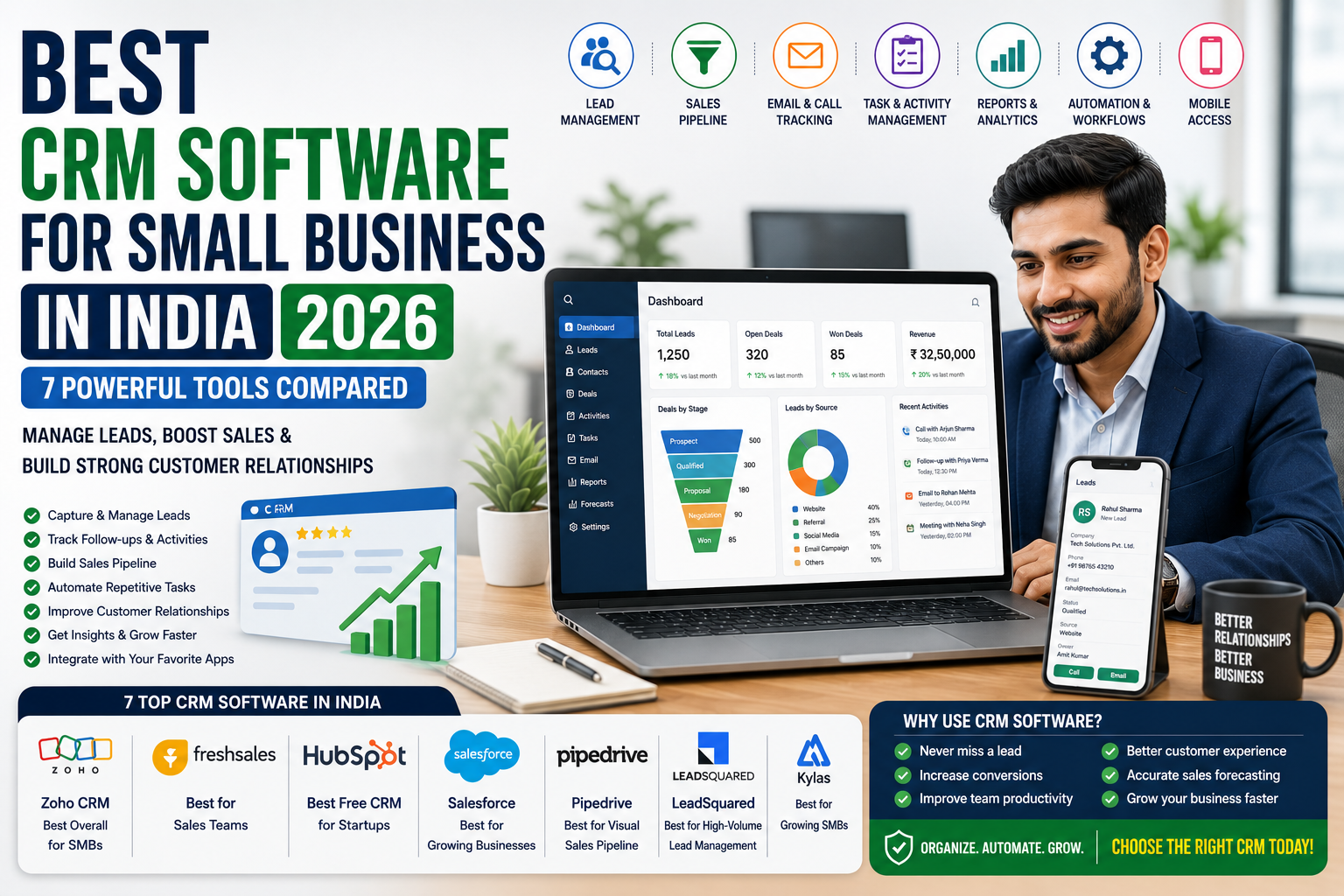
For 2026, seven CRM platforms worth evaluating are:
| CRM Software | Best For | Main Strength |
|---|---|---|
| Zoho CRM | Indian SMBs | Feature depth & value |
| Freshsales | Sales teams | AI + phone-based selling |
| HubSpot CRM | Startups | Strong free CRM |
| Salesforce | Growing enterprises | Advanced customization |
| Pipedrive | Sales-focused teams | Visual sales pipeline |
| LeadSquared | High-volume sales | Lead management & automation |
| Kylas CRM | Growing SMBs | Sales-focused CRM |
Current 2026 market comparisons commonly include Zoho CRM, Freshsales, HubSpot, Salesforce, Pipedrive, LeadSquared and Kylas among notable CRM options for Indian businesses.
1. Zoho CRM — Best Overall for Indian Small Businesses
Zoho CRM is one of the strongest options for Indian small and medium businesses.
It combines lead management, sales automation, analytics, communication and customization in one platform.
Zoho currently offers a free edition for up to 3 users. Its annual pricing currently starts at ₹800 per user/month for Standard, followed by ₹1,400 for Professional, ₹2,400 for Enterprise and ₹2,600 for Ultimate.
Key Features
- Lead management
- Contact management
- Deal management
- Sales pipeline
- Workflow automation
- Sales forecasting
- Email integration
- Analytics
- AI features
- Mobile CRM
- Custom modules
- Marketplace integrations
Zoho CRM’s feature comparison currently lists leads, accounts, contacts, deals, forecasting, automation and other sales-force-automation capabilities across its editions.
Best For
- Indian SMEs
- Agencies
- Real estate
- Education
- Consultants
- SaaS companies
- Service businesses
- Growing sales teams
Pros
- Strong feature set
- Indian company
- INR pricing
- Free plan
- Extensive integrations
- Strong customization
Cons
- Can feel complicated for beginners
- Advanced customization requires higher plans
- Teams need proper setup and training
Verdict: One of the best all-round CRM choices for Indian SMBs.
2. Freshsales — Best for Sales Teams
Freshsales is the CRM platform from Freshworks.
It is particularly attractive for businesses that want a sales-focused interface with communication and AI capabilities.
Key Features
- Lead management
- Contact management
- Deal pipeline
- Phone
- Sales sequences
- AI assistance
- Lead scoring
- Sales reports
- Mobile app
- Workflow automation
Best For
- Telesales teams
- Sales agencies
- Real estate
- Education
- Insurance
- Service businesses
- Startups
A current 2026 India CRM comparison identifies Freshsales as particularly suitable for sales-focused teams and highlights its built-in phone capabilities and AI-assisted sales workflows.
Pros
- Sales-focused interface
- Strong communication tools
- AI capabilities
- Good mobile experience
- Suitable for sales teams
Cons
- Advanced functionality can require higher plans
- Some integrations may require additional configuration
Verdict: A strong option when your sales team spends a lot of time calling and following up with leads.
3. HubSpot CRM — Best Free CRM for Startups
HubSpot CRM is particularly attractive for businesses that want to start with a free CRM.
HubSpot currently offers free CRM tools with no expiration date, including contact management, deal pipelines, CRM import and reporting functionality.
Its current free offering supports up to 2 users and up to 1,000 contacts.
Key Features
- Contact management
- Deal management
- Sales pipeline
- Email tracking
- Meeting scheduling
- Live chat
- Reporting
- CRM import
- AI assistant
- Marketing integration
- Customer service tools
HubSpot currently lists Starter, Professional and Enterprise options above its free CRM, with Starter beginning at $15/month per seat on its CRM product page.
Best For
- Startups
- SaaS businesses
- Marketing agencies
- Inbound sales teams
- Content-driven businesses
Pros
- Free starting option
- Excellent interface
- Strong marketing ecosystem
- Good integrations
- Easy setup
Cons
- Advanced features become expensive
- Indian-specific workflows may require additional tools
- WhatsApp-heavy sales teams should verify integration requirements
Verdict: Excellent for businesses that want to test CRM without an initial software budget.
4. Salesforce — Best for Growing Businesses
Salesforce is one of the world’s best-known CRM platforms.
It provides extensive customization, automation, analytics, integrations and enterprise functionality.
Salesforce’s current India pricing page lists Sales Cloud Starter Suite at $25/user/month, Pro Suite at $100/user/month and Enterprise at $175/user/month, billed according to the listed terms.
Key Features
- Lead management
- Opportunity management
- Sales forecasting
- Workflow automation
- Custom objects
- AI
- Reporting
- Customer service
- Marketing
- App marketplace
- API integrations
Best For
- Growing businesses
- Large sales teams
- Enterprises
- Complex sales processes
- Multi-department organizations
Pros
- Extremely powerful
- Highly customizable
- Huge ecosystem
- Excellent enterprise scalability
Cons
- More expensive
- Can require technical expertise
- More complex than necessary for many small businesses
Verdict: Powerful, but small businesses should make sure they actually need Salesforce-level complexity before investing.
5. Pipedrive — Best for Visual Sales Pipelines
Pipedrive focuses heavily on sales pipeline management.
Its visual approach makes it easy for sales teams to see where every opportunity currently stands.
Key Features
- Deal pipeline
- Lead management
- Activity management
- Email integration
- Sales automation
- Reports
- Forecasting
- Mobile CRM
- Workflow automation
Best For
- B2B sales teams
- Agencies
- Consultants
- Real estate
- SaaS companies
- Businesses with structured sales pipelines
Advantages
- Simple visual pipeline
- Sales-focused
- Easy to understand
- Good activity management
Disadvantages
- Less suitable for businesses wanting a full marketing ecosystem
- Advanced features may require higher plans
- Indian-specific workflows should be checked before purchasing
Verdict: Excellent when your main requirement is managing sales opportunities from lead to closure.
6. LeadSquared — Best for High-Volume Lead Management
LeadSquared is particularly relevant for businesses that manage large numbers of leads.
It combines lead capture, marketing automation and sales management.
Key Features
- Lead capture
- Lead scoring
- Lead distribution
- Sales automation
- Marketing automation
- Landing pages
- Campaign management
- Calling
- Reporting
- Mobile CRM
Best For
- Education
- Healthcare
- Real estate
- Financial services
- Insurance
- High-volume sales businesses
A current 2026 CRM comparison identifies LeadSquared as a strong choice for vertical industries such as education and healthcare.
Pros
- Strong lead automation
- Useful for high-volume sales
- Industry-focused workflows
- Good lead tracking
Cons
- Can be more expensive than basic SMB CRMs
- Setup can require more planning
Verdict: A strong option when your business generates a large number of leads every month.
7. Kylas CRM — Best for Growing Sales Teams
Kylas is a sales-focused CRM designed for growing businesses.
It focuses on helping sales teams manage leads, activities, pipelines and customer interactions.
Key Features
- Lead management
- Contact management
- Deal pipeline
- Sales activities
- Calling
- Automation
- Reports
- Sales tracking
- Mobile access
Best For
- Growing SMBs
- Sales teams
- Real estate
- Education
- Agencies
- Service companies
A current 2026 India comparison lists Kylas among CRM options aimed at growing sales teams and notes its pricing structure as attractive for teams adding users.
Verdict: Worth evaluating for Indian SMBs looking for a sales-first CRM.
CRM Software Comparison
| Feature | Zoho CRM | Freshsales | HubSpot | Salesforce | Pipedrive | LeadSquared | Kylas |
| Lead Management | ✅ | ✅ | ✅ | ✅ | ✅ | ✅ | ✅ |
| Sales Pipeline | ✅ | ✅ | ✅ | ✅ | ⭐⭐⭐⭐⭐ | ✅ | ✅ |
| Automation | ⭐⭐⭐⭐⭐ | ⭐⭐⭐⭐ | ⭐⭐⭐⭐ | ⭐⭐⭐⭐⭐ | ⭐⭐⭐⭐ | ⭐⭐⭐⭐⭐ | ⭐⭐⭐⭐ |
| AI | ✅ | ✅ | ✅ | ✅ | ✅ | ✅ | ✅ |
| Marketing | ✅ | ✅ | ⭐⭐⭐⭐⭐ | ⭐⭐⭐⭐⭐ | ⭐⭐⭐ | ⭐⭐⭐⭐⭐ | ⭐⭐⭐ |
| Mobile App | ✅ | ✅ | ✅ | ✅ | ✅ | ✅ | ✅ |
| Best For | SMB | Sales Teams | Startups | Enterprise | Sales Teams | High-volume Leads | Growing SMB |
| Free Option | ✅ | ✅* | ✅ | Limited | Trial | Trial | Varies |
*Availability and limits depend on the current plan and region.
How CRM Software Works
A typical CRM sales workflow looks like this:
Step 1: Lead Arrives
A customer submits a website form or contacts your business through another channel.
Step 2: Lead Is Added
The CRM stores:
- Name
- Phone
- Company
- Source
- Requirement
Step 3: Lead Is Assigned
The system assigns the lead to the appropriate salesperson.
Step 4: Salesperson Follows Up
The salesperson calls or messages the lead.
The interaction is recorded in the CRM.
Step 5: Deal Is Created
If the prospect is interested, the salesperson creates an opportunity.
Step 6: Deal Moves Through Pipeline
For example:
New Lead → Contacted → Qualified → Proposal → Negotiation → Won
Step 7: Automation
The CRM can automatically create reminders, send emails or assign follow-up tasks.
Step 8: Reporting
Management can see:
- Number of leads
- Conversion rate
- Revenue pipeline
- Salesperson performance
- Lost deals
- Lead sources
This creates a much clearer view of the sales process.
Important CRM Features
When choosing the best CRM software for small business in India, focus on features your team will actually use.
1. Lead Management
The CRM should make it easy to add and organize leads.
2. Sales Pipeline
You should be able to see every opportunity and its current stage.
3. Follow-Up Reminders
Never let an interested prospect disappear because someone forgot to call.
4. WhatsApp Integration
For many Indian businesses, WhatsApp is an important communication channel.
Before buying a CRM, check whether WhatsApp integration is:
- Native
- Third-party
- Paid
- Available only on higher plans
Do not assume “WhatsApp integration” means the same thing across every CRM.
5. Calling
Sales teams that make hundreds of calls may benefit from:
- Click-to-call
- Auto-dialer
- Call recording
- Call tracking
- Call analytics
6. Automation
Automation can handle repetitive tasks such as:
- Lead assignment
- Follow-up reminders
- Email sequences
- Status updates
- Notifications
7. Reporting
Managers should be able to understand:
- Sales pipeline
- Conversion rates
- Revenue
- Lead sources
- Salesperson performance
CRM for WhatsApp-Based Businesses
WhatsApp is particularly important for many Indian businesses.
A typical workflow might look like:
Facebook Ad → WhatsApp Enquiry → CRM Lead → Salesperson → Follow-Up → Proposal → Sale
Without a CRM, this process can become difficult to track.
With a properly integrated system, the business can create a structured sales journey.
Businesses That Can Benefit
- Real estate
- Education
- Insurance
- Loans
- Digital agencies
- Travel
- Healthcare
- Automotive
- Local services
- B2B sales
Important
WhatsApp Business API usage, messaging rules and charges are separate considerations from the CRM subscription.
Always check the current WhatsApp/Meta requirements before implementing automated messaging.
How to Choose a CRM
For 1–3 Users
Start simple.
HubSpot Free or Zoho CRM Free can be useful options.
Zoho currently provides its free CRM edition for up to three users, while HubSpot’s current free tools support up to two users.
For 5–20 Users
Consider:
- Zoho CRM
- Freshsales
- HubSpot
- Kylas
- Pipedrive
Focus on:
- Price
- Ease of use
- Follow-ups
- Calling
- Automation
For 20–100 Users
Look at:
- Advanced automation
- Role-based permissions
- Sales reporting
- Territory management
- Integrations
- API access
Zoho CRM, Freshsales, LeadSquared and Kylas can be worth comparing.
For 100+ Users
You may need:
- Enterprise security
- Multiple teams
- Advanced analytics
- Complex workflows
- Custom objects
- API integrations
- Dedicated support
Salesforce becomes more relevant at this level, although enterprise-grade Zoho, HubSpot and other platforms can also be considered.
CRM Pricing in India
CRM pricing varies significantly.
Zoho currently lists:
| Zoho CRM Plan | Current Annual Price |
| Free | Free for 3 users |
| Standard | ₹800/user/month |
| Professional | ₹1,400/user/month |
| Enterprise | ₹2,400/user/month |
| Ultimate | ₹2,600/user/month |
These prices are listed by Zoho and local taxes are charged in addition.
HubSpot currently provides a free CRM option, while its CRM product page lists Starter from $15/month per seat, Professional from $50 and Enterprise from $75.
Salesforce’s current Sales Cloud pricing lists Starter Suite at $25/user/month, Pro at $100 and Enterprise at $175.
Do Not Compare Only the Monthly Price
Also check:
- Number of users
- Automation limits
- Contact limits
- API limits
- WhatsApp integration
- Calling charges
- Storage
- Reporting
- Support
- Implementation cost
- Additional modules
A cheap CRM can become expensive if important features require multiple add-ons.
CRM vs Excel
| Feature | Excel | CRM |
| Lead Database | ✅ | ✅ |
| Sales Pipeline | Manual | ✅ |
| Automatic Follow-Ups | ❌ | ✅ |
| Lead Assignment | Manual | ✅ |
| Sales Reports | Manual | ✅ |
| Team Collaboration | Limited | ✅ |
| Call Tracking | ❌ | ✅ |
| Email Tracking | ❌ | ✅ |
| Automation | Limited | ✅ |
| Customer History | Manual | ✅ |
Excel can still work for a very small operation.
But when several people are selling simultaneously, a CRM usually provides much better visibility.
Common CRM Mistakes
Mistake 1: Buying Too Many Features
A small business does not necessarily need enterprise-level CRM functionality.
Start with your actual sales process.
Mistake 2: Not Training the Team
Even the best CRM fails if salespeople do not update it.
Mistake 3: Making the CRM Too Complicated
Keep the initial pipeline simple.
For example:
New → Contacted → Qualified → Proposal → Won/Lost
Add complexity later.
Mistake 4: Ignoring Data Quality
Duplicate contacts and incorrect phone numbers make CRM reports unreliable.
Mistake 5: Not Defining Follow-Up Rules
Decide:
- Who calls a new lead?
- How quickly?
- How many follow-ups?
- When is the lead considered lost?
Mistake 6: Choosing Based Only on AI
AI can help with lead scoring, summaries and recommendations.
But basic CRM usability still matters more.
Frequently Asked Questions
What is the best CRM software for small business in India?
For many Indian SMBs, Zoho CRM is a strong overall choice because of its feature depth, INR pricing and free entry plan. Freshsales is worth considering for sales-heavy teams, HubSpot for startups wanting a free CRM, and Salesforce for businesses with complex enterprise requirements.
Which CRM is best for a small business?
The best CRM is the one your team actually uses consistently. For a small Indian team, affordability, simple lead management, follow-ups, mobile access and relevant communication integrations can matter more than having hundreds of advanced features.
Is Zoho CRM free?
Yes. Zoho currently offers a free CRM edition for up to three users. Paid annual plans currently start at ₹800 per user/month for Standard.
Is HubSpot CRM really free?
HubSpot currently offers free CRM tools with no expiration date. Its current free offering includes core CRM capabilities, although user and contact limits apply.
Which CRM is best for WhatsApp leads?
The answer depends on the specific WhatsApp integration offered by each CRM and plan. Indian businesses should compare native WhatsApp support, API requirements, automation, messaging costs and whether a third-party connector is required.
Which CRM is best for real estate?
Real-estate companies usually need lead capture, calling, follow-up reminders, site-visit tracking and sales pipelines. Zoho CRM, Freshsales, LeadSquared and Kylas can all be evaluated depending on the team’s workflow.
Which CRM is best for education businesses?
Education companies often need high-volume lead management, automated follow-ups, calling and lead scoring. LeadSquared can be particularly relevant for high-volume education sales workflows.
Is CRM software worth it for a small business?
It can be, especially when the company has multiple salespeople or receives leads from several channels. The main benefit is creating a consistent system for tracking leads and follow-ups.
Final Verdict
The best CRM software for small business in India is not necessarily the CRM with the most features.
Choose Zoho CRM if you want a powerful all-round CRM with strong value and Indian-market suitability.
Choose Freshsales if your team is heavily focused on sales calls and follow-ups.
Choose HubSpot if you want to start with a free CRM and potentially expand into marketing and customer service.
Choose Salesforce if your company expects complex processes and significant future growth.
Choose Pipedrive if your primary requirement is a clean visual sales pipeline.
Choose LeadSquared if your business generates and manages a large volume of leads.
Choose Kylas if you want a sales-focused CRM for a growing Indian SMB.
The most important CRM metric is not the number of features.
It is how consistently your team uses the system.
A simple CRM that every salesperson updates every day is far more valuable than an expensive platform filled with features nobody uses.
Before buying, compare:
Price + ease of use + lead management + follow-ups + WhatsApp + calling + automation + reporting + integrations.
Start small, import real leads, test the workflow with your sales team and upgrade only when your business actually needs more functionality.