
Table of Contents
- What Is Expense Management Software?
- Why Small Businesses Need Expense Management Software
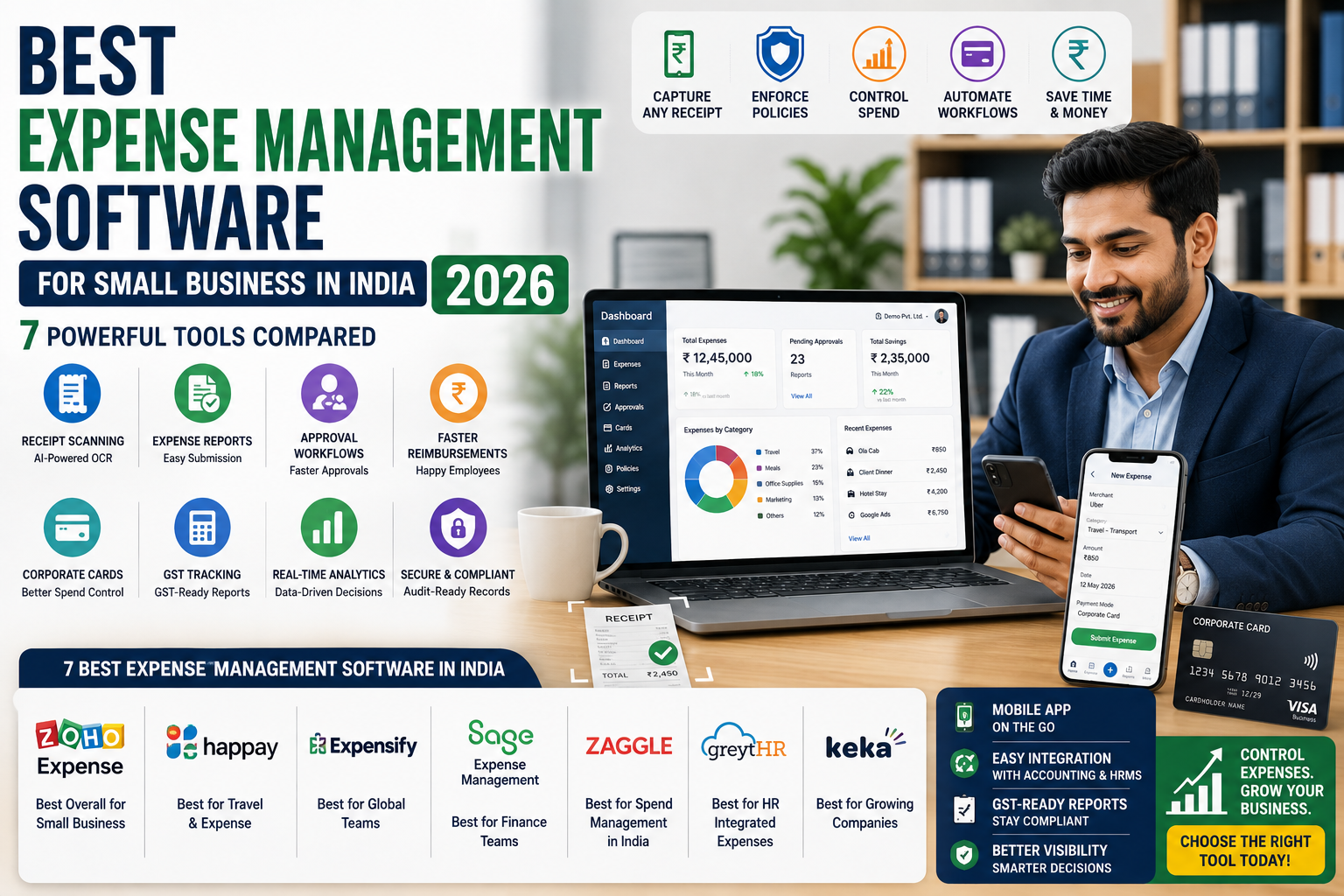
- Best Expense Management Software in India
- Expense Management Software Comparison
- Zoho Expense
- Happay
- Expensify
- Sage Expense Management
- Zaggle
- greytHR Expense Management
- Keka
- How Expense Management Software Works
- Features to Look For
- GST and Expense Management
- How to Choose the Right Software
- Expense Management Software Pricing
- Common Mistakes to Avoid
- Frequently Asked Questions
- Final Verdict
What Is Expense Management Software?
Expense management software is a digital platform that helps businesses record, review, approve, reimburse and analyze business expenses.
Instead of collecting receipts through WhatsApp, email, paper files and spreadsheets, employees can submit expenses through a centralized system.
Finance teams can then review the expenses, apply company policies, approve claims and send the information to accounting systems.
The best expense management software for small business in India should make expense reporting easier while giving the business better control over spending.
Modern platforms can include:
- Receipt scanning
- Expense reports
- Approval workflows
- Employee reimbursements
- Corporate card management
- GST tracking
- Policy controls
- Accounting integrations
- Analytics
- Mobile applications
Why Small Businesses Need Expense Management Software
Small businesses often start by tracking expenses manually.
An employee sends a receipt over WhatsApp.
The finance person copies the amount into Excel.
The manager approves the claim by email.
Then someone enters the information into accounting software.
This process becomes difficult as the company grows.
A modern expense system can centralize the workflow.
Current 2026 industry guidance highlights automation, faster approvals, policy enforcement, mobile access, analytics and accounting integrations as important features when selecting expense-management software.
Main Benefits
Faster Reimbursements: Employees can submit claims digitally.
Less Manual Work: Receipt data can be captured automatically.
Better Control: Finance teams can enforce expense policies.
Improved Visibility: Managers can see where money is being spent.
Fewer Errors: Automated workflows reduce manual data entry.
Better Audit Trail: Digital approvals create a record of who submitted and approved an expense.
Best Expense Management Software for Small Business in India
The right software depends on your employee count, spending volume, accounting system and whether you need corporate cards or travel management.
Seven platforms worth evaluating in 2026 are:
| Software | Best For | Main Strength |
|---|---|---|
| Zoho Expense | Small businesses | Affordable expense automation |
| Happay | Travel & expense | End-to-end T&E management |
| Expensify | Global teams | AI-powered expense workflows |
| Sage Expense Management | Growing businesses | Expense automation & accounting |
| Zaggle | Indian enterprises | Spend & payment management |
| greytHR | HR-integrated expenses | HR + expense management |
| Keka | Growing companies | HRMS + expense workflows |
A current 2026 comparison from greytHR includes Zoho Expense, Keka, PocketHRMS, factoHR, Zimyo, HROne, Qandle, Paybooks and ZingHR among the leading expense-management options in India.
1. Zoho Expense — Best Overall for Small Businesses
Zoho Expense is a cloud-based expense management platform designed for businesses that want to automate expense reporting and reimbursement.
It is particularly attractive to smaller companies because of its low entry cost and integration with the wider Zoho ecosystem.
Zoho currently offers a Free plan for up to 3 users in India. Its Standard plan is currently listed at ₹79 per user/month when billed annually, while the monthly price is ₹99 per user/month.
Key Features
- Receipt scanning
- AI-powered OCR
- Expense reports
- Mileage tracking
- Expense approvals
- Corporate card management
- GST tracking
- Multi-currency expenses
- Accounting integrations
- Expense policies
- Automated reminders
- Project/customer expense tracking
- Mobile application
Zoho’s current comparison also lists GST tracking, corporate-card management, automated expense reports, multi-GSTIN support and workflow automation among its capabilities.
Best For
- Startups
- Small businesses
- Agencies
- Consultants
- SaaS companies
- Remote teams
Pros
- Low entry price
- Free plan
- AI receipt scanning
- Strong Zoho integrations
- Mobile expense reporting
- GST-related features
Cons
- Advanced features require paid plans
- Larger organizations may need more sophisticated spend controls
Verdict: One of the best starting points for a small business that wants affordable expense automation.
2. Happay — Best for Travel and Expense Management
Happay focuses heavily on travel and expense management.
Its platform combines expense capture, approvals, reimbursements, corporate cards, travel management and analytics.
Happay’s current platform supports automated expense capture from multiple sources, policy checks, approval workflows, reimbursements and analytics.
Key Features
- Receipt capture
- OCR
- Expense reports
- Corporate cards
- Travel booking
- Reimbursements
- Approval workflows
- Policy enforcement
- GST management
- Spend analytics
- ERP integrations
- HRMS integrations
Happay says its Xpendite system can capture expense information from sources including card statements, SMS, email and other channels, while SmartAudit can flag duplicate invoices, mismatches and policy violations.
Best For
- Businesses with frequent travel
- Sales teams
- Field employees
- Mid-size companies
- Enterprises
- Companies needing corporate cards
Pros
- Strong travel integration
- Automated expense capture
- Corporate card capabilities
- Advanced analytics
- Policy controls
Cons
- May be more than a very small business needs
- Enterprise-oriented features can increase complexity
Verdict: Excellent when travel, employee expenses and corporate cards need to work together.
3. Expensify — Best for Global Expense Management
Expensify is an established expense-management platform with strong receipt capture, expense reports, reimbursement and accounting integrations.
Its current product supports receipt scanning through mobile, drag-and-drop, email and text, while its AI assistant can categorize and submit expenses.
Key Features
- Receipt scanning
- AI expense categorization
- Expense reports
- Reimbursements
- Expense policies
- Corporate cards
- Spend controls
- Mileage tracking
- Accounting integrations
- Analytics
Expensify has continued adding AI and spend-control capabilities during 2026. Its June 2026 update added AI-agent functionality and real-time card controls based on merchant, category, amount and currency.
Best For
- International companies
- Remote teams
- Freelancers
- Agencies
- Businesses with employees in multiple countries
Pros
- Strong mobile experience
- AI automation
- Global capabilities
- Accounting integrations
- Expense-policy controls
Cons
- Indian businesses should verify local GST and tax workflow requirements
- Pricing and features depend on plan and region
Verdict: A strong option for businesses with international operations or globally distributed teams.
4. Sage Expense Management — Best for Growing Finance Teams
Sage Expense Management, formerly known as Fyle, focuses on automating expense reporting and improving visibility for finance teams.
Its current product updates emphasize faster reimbursements, smarter automation, reconciliation and spend visibility.
Key Features
- Expense reporting
- Receipt capture
- Approval workflows
- Corporate card reconciliation
- Employee reimbursements
- Accounting integrations
- Budget visibility
- Expense policies
- Spend analytics
Best For
- Growing companies
- Finance teams
- Professional services
- Companies using accounting software
- Businesses with significant employee expenses
Verdict: Worth evaluating when finance teams need deeper expense automation and accounting integration.
5. Zaggle — Best for Spend Management in India
Zaggle takes a broader approach to business spend management.
Rather than focusing only on employee reimbursement, its platform covers travel and expenses, cards, payments, recurring business expenses and other spend workflows.
Zaggle currently highlights automated approvals, real-time visibility, policy controls, corporate cards and payment integration.
Key Features
- Employee expenses
- Travel management
- Corporate cards
- Prepaid cards
- Approval workflows
- Reimbursements
- Recurring expenses
- Petty cash
- Payments
- Spend analytics
- Accounting integrations
Best For
- Growing Indian businesses
- Mid-size companies
- Enterprises
- Companies with multiple branches
- Businesses needing spend controls
Pros
- Broad spend-management capabilities
- Corporate card support
- Indian business focus
- Real-time visibility
- Multiple workflows
Cons
- May be too advanced for a very small team
- Pricing may require a sales discussion
Verdict: A strong choice when expense management needs to evolve into broader spend management.
6. greytHR — Best for HR-Integrated Expense Management
Businesses already using an HRMS may prefer an expense system integrated with employee information, payroll and HR workflows.
greytHR’s 2026 expense-management comparison positions it alongside Zoho Expense, Keka, PocketHRMS, factoHR and other HR-focused platforms.
Useful For
- Employee reimbursements
- Travel claims
- Expense approvals
- HR workflows
- Employee records
- Payroll integration
Best For
- SMEs
- HR departments
- Businesses already using greytHR
- Companies wanting HR and expense management together
Verdict: A sensible choice when employee expenses are closely connected with HR and payroll.
7. Keka — Best for Growing HR Teams
Keka is primarily known as an HR and payroll platform, but its broader HRMS ecosystem can also support employee expense workflows.
For a growing business that wants HR, payroll, attendance and expense processes in a connected platform, this approach can reduce the number of separate systems employees need to use.
Keka is included among leading expense-management platforms in a current 2026 India comparison.
Best For
- Growing startups
- Technology companies
- Service businesses
- HR teams
- Mid-size organizations
Verdict: Particularly useful when expense management is part of a larger HR technology strategy.
Expense Management Software Comparison
| Software | Best For | Receipt Automation | Approvals | Corporate Cards | Analytics |
| Zoho Expense | Small Business | ⭐⭐⭐⭐⭐ | ⭐⭐⭐⭐ | ⭐⭐⭐⭐ | ⭐⭐⭐⭐ |
| Happay | Travel & Expense | ⭐⭐⭐⭐⭐ | ⭐⭐⭐⭐⭐ | ⭐⭐⭐⭐⭐ | ⭐⭐⭐⭐⭐ |
| Expensify | Global Teams | ⭐⭐⭐⭐⭐ | ⭐⭐⭐⭐ | ⭐⭐⭐⭐ | ⭐⭐⭐⭐ |
| Sage Expense Management | Finance Teams | ⭐⭐⭐⭐ | ⭐⭐⭐⭐⭐ | ⭐⭐⭐⭐ | ⭐⭐⭐⭐ |
| Zaggle | Spend Management | ⭐⭐⭐⭐ | ⭐⭐⭐⭐⭐ | ⭐⭐⭐⭐⭐ | ⭐⭐⭐⭐⭐ |
| greytHR | HR Teams | ⭐⭐⭐ | ⭐⭐⭐⭐ | ⭐⭐⭐ | ⭐⭐⭐ |
| Keka | Growing Companies | ⭐⭐⭐ | ⭐⭐⭐⭐ | ⭐⭐⭐ | ⭐⭐⭐⭐ |
Note: These are editorial ratings based on feature positioning and current product information, not independent certification or performance benchmarks.
How Expense Management Software Works
A typical automated expense process looks like this:
Step 1: Employee Makes a Business Purchase
For example, an employee spends ₹2,500 on a customer meeting.
Step 2: Receipt Is Captured
The employee uploads a photo of the receipt.
OCR can extract information such as:
- Merchant
- Date
- Amount
- Tax
- Invoice number
Step 3: Expense Is Categorized
The system assigns the expense to a category such as:
Travel → Meals
Step 4: Policy Is Checked
The software checks whether the expense follows company rules.
For example:
Maximum meal allowance = ₹1,500
If the employee submits ₹2,500, the system can flag the expense.
Step 5: Manager Approves
The expense is automatically routed to the appropriate manager.
Step 6: Finance Processes Reimbursement
After approval, the finance team can process the reimbursement.
Step 7: Accounting Sync
The approved transaction can be transferred to accounting software.
This workflow can eliminate a large amount of manual work.
Features to Look For
Before choosing the best expense management software for small business in India, compare the following features.
1. Receipt OCR
The software should be able to read receipts automatically.
This is one of the biggest time-saving features.
2. Mobile Application
Employees should be able to submit expenses immediately rather than saving receipts for the end of the month.
3. Approval Workflows
Look for customizable approval rules.
For example:
Below ₹5,000 → Manager
₹5,000–₹25,000 → Department Head
Above ₹25,000 → Finance Director
4. Expense Policies
The software should allow businesses to define rules for:
- Meals
- Travel
- Hotels
- Fuel
- Entertainment
- Office supplies
- Client expenses
5. Corporate Card Integration
If your employees use corporate cards, check whether transactions can be imported automatically.
6. Accounting Integration
Important integrations can include:
- Zoho Books
- Tally
- QuickBooks
- Xero
- NetSuite
- ERP systems
7. Analytics
Finance teams should be able to analyze:
- Department spending
- Employee spending
- Vendor spending
- Monthly expenses
- Budget utilization
- Policy violations
GST and Expense Management
GST is an important consideration for Indian businesses.
Expense-management software can help capture GST-related information from invoices and receipts.
For businesses that are eligible to claim input tax credit, accurate invoice data can be particularly important.
Zoho Expense currently lists GST tracking among its expense-management capabilities.
Happay also currently promotes GST automation within its travel and expense platform.
GST Information That May Matter
Depending on the transaction and applicable rules:
- GSTIN
- Invoice number
- Invoice date
- Taxable amount
- CGST
- SGST
- IGST
- Vendor details
Important: Software does not automatically guarantee that an expense is eligible for input tax credit. Businesses should verify GST eligibility and documentation requirements with their tax professional.
How to Choose the Right Software
For 1–10 Employees
Start with a low-cost solution.
Zoho Expense is particularly worth evaluating because its current free plan supports up to three users.
For 10–50 Employees
Look for:
- Approval workflows
- Mobile expense submission
- Accounting integration
- GST tracking
- Reimbursements
Zoho Expense, greytHR and Keka can be considered depending on whether you want standalone expense software or a broader HR platform.
For 50–500 Employees
Consider:
- Corporate cards
- Multi-level approvals
- Budget controls
- Analytics
- Multiple departments
- HRMS integration
Happay and Zaggle become more relevant for businesses with larger spend-management requirements.
For 500+ Employees
Focus on:
- Multi-entity support
- Advanced permissions
- ERP integrations
- Audit controls
- Corporate cards
- Global operations
- Advanced analytics
Enterprise platforms may provide significantly more control than basic expense-reporting applications.
Expense Management Software Pricing
Pricing varies significantly between vendors.
For example, Zoho Expense currently lists:
Free: ₹0 for up to 3 users
Standard: ₹79/user/month when billed annually
Premium: ₹149/user/month when billed annually
These are current listed prices and can change.
Other platforms may use:
- Per-user pricing
- Per-report pricing
- Custom enterprise pricing
- Platform fees
- Corporate-card fees
- Implementation charges
Before Buying, Ask About
- Setup fees
- Minimum users
- Annual commitment
- Additional storage
- Corporate card charges
- Integrations
- Support
- Implementation
- GST-related features
- API access
Do not compare platforms only on their advertised monthly price.
Expense Management Software vs Excel
| Feature | Excel | Expense Software |
| Receipt OCR | ❌ | ✅ |
| Automatic Approval | ❌ | ✅ |
| Mobile Submission | Limited | ✅ |
| Policy Enforcement | Manual | ✅ |
| Real-Time Analytics | Manual | ✅ |
| Audit Trail | Limited | ✅ |
| Reimbursement Workflow | Manual | ✅ |
| Corporate Card Integration | Limited | ✅ |
| Accounting Integration | Manual | ✅ |
Excel can still be useful for simple businesses.
But once multiple employees, departments and expense categories are involved, automation can provide significant operational benefits.
Common Expense Management Mistakes
Mistake 1: Keeping Everything in WhatsApp
WhatsApp is convenient for communication but is not a proper financial record system.
Mistake 2: Waiting Until Month-End
Employees should submit expenses close to the time of purchase.
This reduces lost receipts and forgotten transactions.
Mistake 3: No Expense Policy
Create clear rules for:
- Travel
- Meals
- Hotels
- Fuel
- Client entertainment
- Office purchases
Mistake 4: No Approval Hierarchy
Every expense should have a defined approval path.
Mistake 5: Ignoring Corporate Cards
If employees use cards, integrate the transactions where possible.
Mistake 6: Not Checking Duplicate Claims
Duplicate reimbursement can create unnecessary financial leakage.
Automated systems can flag potential duplicates and policy violations.
Happay’s current SmartAudit feature, for example, is designed to detect duplicate invoices, mismatches and other policy issues.
Frequently Asked Questions
What is the best expense management software for small business in India?
For many small businesses, Zoho Expense is a strong starting point because of its low pricing and free plan. Happay and Zaggle can be better suited to businesses requiring broader travel, corporate-card and spend-management capabilities.
Is expense management software worth it for a small business?
It can be worthwhile once employees regularly submit reimbursements, business travel increases or finance teams spend significant time reconciling receipts and spreadsheets.
Is Zoho Expense free?
Zoho currently offers a free India plan for up to three users. Its paid Standard plan is currently listed at ₹79 per user/month when billed annually.
Can expense software track GST?
Some platforms provide GST-related expense tracking and invoice-data capture. Zoho Expense and Happay currently promote GST-related functionality.
Can employees submit expenses from their phones?
Yes. Modern expense-management platforms generally provide mobile apps or mobile-friendly workflows for receipt capture and expense submission.
Can expense software integrate with accounting software?
Yes. Many platforms provide integrations with accounting and ERP systems. Expensify, for example, currently supports accounting synchronization with systems including QuickBooks, Sage Intacct, NetSuite and Xero.
What is the difference between expense management and spend management?
Expense management usually focuses on employee expenses, receipts, approvals and reimbursements.
Spend management is broader and can include corporate cards, procurement, recurring expenses, payments, budgets and other company spending.
Is expense management software secure?
Security varies by provider. Before choosing a platform, review encryption, authentication, access controls, audit logs, data backups and compliance certifications.
Final Verdict
The best expense management software for small business in India depends on how complicated your company’s spending process has become.
Choose Zoho Expense if you want affordable, cloud-based expense management with a low entry cost.
Choose Happay if travel, corporate cards and employee expenses are major parts of your business.
Choose Expensify if your company has international employees or global expense requirements.
Choose Sage Expense Management if finance automation and accounting workflows are important.
Choose Zaggle if you want broader spend management, cards, travel and payment controls.
Choose greytHR if employee expenses need to work closely with your HR processes.
Choose Keka if you want expense management as part of a broader HRMS.
The biggest benefit of expense software is not simply replacing Excel.
It is creating a controlled financial workflow where expenses are captured, checked, approved, reimbursed and recorded with less manual work.
Before purchasing, compare:
Price + automation + GST support + approval workflows + accounting integrations + security + scalability.
The cheapest tool is not always the best tool.
The best platform is the one that reduces administrative work while giving your finance team better visibility and control over every rupee the business spends.